Showing posts with label Section 1: Principles of chemistry. Show all posts

Saturday, 24 March 2018

Section 1 i) Summary

Electrolysis is defined as chemical decomposition produced by passing an electric current through a liquid or solution containing ions. This process by which we can obtain the individual elements from an ionic compound has truly revolutionised the world.

Ionic compounds do not conduct electricity while solid. This is because the ions are not free to move. When aqueous, the ions are dissociated and therefore are able to move freely. When molten, the bonds between the ions are broken and they are able to move freely. Electricity is able to pass through because there are free-moving charged particles that can carry current.
Ionic compounds have very high melting points, and because of this the solid is often dissolved in water to create an aqueous electrolyte. When molten ionic compounds are electrolysed, the rules are simple: Metal goes to the cathode, Non-metal to the anode. But with aqueous solutions, it is less simple.

At the anode: If the non-metal is a halogen, it will form at the anode. If it is not, hydrogen gas will form: 2H+ + 2e- --> H2

At the cathode: If the metal is a low reactivity metal, it will coat the cathode. If it is a high reactivity metal, oxygen gas will form: 4OH- --> O2 + 4H2O + 4e-


The amount of a substance removed can be calculated by how much charge has passed through.
1 mole of electrons is equal to 1 faraday, which is 96500 coulombs.
First, you have to know the ionic half equation, the current passing through, and the time it takes.
Then, you can calculate the charge with this equation:
Charge (in coulombs) = Current (in amps) x Time (in seconds)
Q = I T
Divide the charge you have just calculated by 96500 to get the number of faradays, which is how many moles of electrons transferred.
Then look at the equation to see how many moles of electrons there are for each mole of the product, and divide accordingly.
If you are trying to find the mass, multiply by Mr, and you will have mass in grams
If you are trying to find the gas volume, multiply by 24000 to get volume in cm3.
See examples in the specification here

Industry
One of the most common industrial uses of electrolysis is the electrolysis of brine, or sodium chloride. This is called chlor-alkali industry.

The products of this reaction are used for many different things:

Chlorine: killing bacteria, making bleach, making hydrochloric acid, etc.

Hydrogen: used in making ammonia, making margarine, etc.

Sodium hydroxide: Making soap, paper, ceramics, etc.

The ionic half-equations are:

2Cl- --> Cl2 + 2e-

2H+ + 2e- --> H2

Because two gases are formed, a diaphragm is put in place between the two electrodes to prevent them from mixing and reacting.

Section 1 i) Key Words

Anode: Positive electrode. Attracts negative anions.

Anions: Negatively charged ions

Cathode: Negative electrode. Attracts positive cations.

Cations: Positively charged ions

Electrode: A conductor placed in an electrolyte to electrolyse it

Electrolysis: The process by which a molten or aqueous ionic compound is separated by passing a current through.

Electrolyte: A molten or aqueous ionic compound that conducts electricity.

Half equation: An ionic half equation includes only half a chemical reaction, it just shows what is happening at the individual electrodes with the transfer of electrons.

Section 1 i) Specification

1.48 understand that an electric current is a flow of electrons or ions

Electric current is the movement of charged particles in a sort of stream. Usually it is in reference to electrons, but free ions can also conduct electricity/carry charge, as they are charged particles.

1.49 understand why covalent compounds do not conduct electricity

In covalent compounds, there are no free charged particles (no delocalised electrons, no ions) available to carry charge.

1.50 understand why ionic compounds conduct electricity only when molten or in
solution

Ionic compounds, when solid, do not conduct electricity. This is because the ions are not free to move; they are held in place by strong ionic bonding. When molten or aqueous, the ions become free and can then carry electrical charge.

1.51 describe experiments to distinguish between electrolytes and nonelectrolytes

Make a simple circuit involving a buzzer or a lightbulb, then, in series with the chosen component, place a beaker containing the liquid in question with electrodes attached into the circuit. If the component works, it is an electrolyte, because it allowed current to flow through. If the component does not work, it is a nonelectrolyte as it has broken the connection of the circuit.

1.52 understand that electrolysis involves the formation of new substances when
ionic compounds conduct electricity

Electrolysis is a process designed to separate ionic compounds and re-form them back into their individual elements.

1.53 describe experiments to investigate electrolysis, using inert electrodes, of
molten salts such as lead(II) bromide and predict the products


  1. Place carbon electrodes into a beaker containing lead bromide, so they are submerged. 
  2. Hook the electrodes up to a cell and allow current to flow for some time.
  3. At the cathode (negative electrode), positive metal ions will be reduced, in this case lead will form. 
  4. At the anode (positive electrode), negative non-metal ions will be attracted and oxidised, in this case bromine will form. 

1.54 describe experiments to investigate electrolysis, using inert
electrodes, of aqueous solutions such as sodium chloride, copper(II)
sulfate and dilute sulfuric acid and predict the products

Sodium chloride
  1. Place carbon electrodes into a beaker containing lead bromide, so they are submerged. 
  2. Hook the electrodes up to a cell and allow current to flow for some time.
  3. At the cathode (negative electrode), positive hydrogen ions will be reduced, and bubbles of hydrogen gas will form
  4. At the anode (positive electrode), negative halide ions will be attracted and oxidised, in this case chlorine will form. 
Copper (II) sulphate
  1. Place carbon electrodes into a beaker containing lead bromide, so they are submerged. 
  2. Hook the electrodes up to a cell and allow current to flow for some time.
  3. At the cathode (negative electrode), positive copper ions will be reduced, and copper will coat the electrode.
  4. At the anode (positive electrode), negative hydroxide ions will be attracted and oxidised, and bubbles of oxygen gas will form. 

Dilute sulphuric acid
  1. Place carbon electrodes into a beaker containing lead bromide, so they are submerged. 
  2. Hook the electrodes up to a cell and allow current to flow for some time.
  3. At the cathode (negative electrode), positive hydrogen ions will be reduced, and bubbles of hydrogen gas will form
  4. At the anode (positive electrode), negative hydroxide ions will be attracted and oxidised, and bubbles of oxygen gas will form.
1.55 write ionic half-equations representing the reactions at the electrodes during
electrolysis

Lead bromide
Cathode: Pb2+ + 2e- --> Pb
Anode: 2Br- --> Br2 + 2e-

Sodium chloride
Cathode: 2H+ + 2e- --> H2
Anode: 2Cl- --> Cl2 + 2e-

Copper (II) sulphate
Cathode: Cu2+ + 2e- --> Cu
Anode: 4OH- --> O2 + H2O + 4e-

Dilute Sulphuric acid
Cathode: 2H+ + 2e- --> H2
Anode: 4OH- --> O2 +H2O + 4e-

1.56 recall that one faraday represents one mole of electrons

One faraday = 96500 coulombs = 1 mole of electrons

1.57 calculate the amounts of the products of the electrolysis of molten
salts and aqueous solutions.

If a current of 1.5A is passed through lead bromide for 1 hour, how much lead will form?
Half equation: Pb2+ + 2e- --> Pb
Coulombs = Current (in amperes) x Time (in seconds) = 5400 C

Conversion into moles of electrons:
1 mole = 1 faraday = 96500 coulombs
5400 / 96500 = 54/965 mol

There are 2 moles of electrons for every mole of lead, so divide by 2 = 27/965 mol
Then multiply by Mr to find mass 27/965 x 207 = 5.79 g 


If a current of 2A is passed through sodium chloride for 2 hours, what volume of chlorine will form?
Half equation: 2Cl- --> Cl2 + 2e-
Q = I T = 14400 C

1 mole = 1 faraday - 96500 C
14400 / 96500 = 144/965 mol

2 electrons per atom, so divide by 2 = 72/965 mol
Then multiply by 24 000 to find volume in cm3 72/965 x 24000 = 1790.67 cm3


If a current of 4.2A is passed through copper (II) sulphate for 45 minutes, what mass of copper will be formed?
Half equation: Cu2+ + 2e- --> Cu
Q = I T = 11340C

11340 / 96500 = 567/4825 mol

2 electrons per atom, so divide by 2 = 567/9650 mol
Then multiply by Mr 567/9650 x 63.5 = 3.73 g


If a current of 0.2A is passed through dilute sulphuric acid for 5 hours and 45 minutes, what volume of hydrogen is produced?
Half equation: 2H+ + 2e- --> H2
Q = I T = (5 x 60 + 45) x 60 x 0.2 = 4140C

4140 / 96500 = 207/4825 mol

2 moles of electrons per mole of hydrogen, so divide by 2 = 207/9650 mol
Then multiply by 24 000 to get the volume in cubic centimetres 207/9650 x 24 000 = 514.82 cm3

Section 1 h) Summary

When metals bond, they form a giant metallic structure, also known as a metallic crystal. They are made up of positively charged nuclei surrounded by a delocalised electrons, sometimes referred to as a 'sea of free electrons'. These free electrons allow metals to conduct electricity, as they are able to move and carry charge freely. 
This structure is a giant structure, meaning it is constantly repeating regularly. It is in sort of layers which mean that when force is applied, the ions will slide, and the metal will bend, not break. 

The strong forces of attraction between the electrons and charged metal ions are difficult to break; they require a lot of energy. This means that metals have high melting and boiling points. 

Metals are also:
  • Shiny/lustrous: The giant structure means it has flat, smooth surfaces that reflect light.
  • Hard: The giant structure is densely packed and difficult to dent
  • High density: The ions are packed closely together, only tiny electrons keeping them apart
  • Strong: The giant structure is difficult to break 

Section 1 h) Key Words

Delocalised electrons: Electrons that are not tied to a specific nucleus, they are free to move around and allow electricity to be conducted.

Ductile: Able to be stretched out/pulled out into a wire. Metals are ductile.

Giant structure: A constantly repeating lattice structure of molecules, it doesn't end until there aren't enough molecules to add more.

Malleable: Easily bent when force is applied, the opposite of brittle.

Section 1 h) Specification

1.46 understand that a metal can be described as a giant structure of positive
ions surrounded by a sea of delocalised electrons

In metallic bonding, the positive ions are regularly arranged in a giant structure. These are surrounded by a sea of delocalised electrons, without which the cations would repel each other; the attraction between the positive ions and electrons holds the structure together.

1.47 explain the electrical conductivity and malleability of a metal in terms of its
structure and bonding.

Metal is a good conductor of both electricity and heat. This is because of its sea of delocalised electrons that are free to move and carry charge.
Metal is malleable and ductile because of its giant structure. It is in layers that can slip past one another when force is applied, as opposed to snapping. 

Friday, 23 March 2018

Section 1 g) Summary

Covalent bonding is the bonding of two non-metal atoms. It involves a shared pair of electrons. The attraction between the nucleus of each of the atoms and the electrons of the other atom creates a very strong covalent bond.

Simple covalent structures usually have low melting and boiling points, and are often fluid at room temperature, because the forces between the molecules are weak and don't require much energy to break. They have weak intermolecular forces.
Examples include: water, oxygen, carbon dioxide, hydrogen chloride, etc.

Giant covalent structures have very high melting and boiling points, because they have so many strong covalent bonds holding the atoms together. It requires a lot of energy to break that many covalent bonds, so they have high melting points.
Examples include: diamond (carbon), graphite (carbon), silicon dioxide, etc.

Dot and cross diagrams can be used to represent covalent bonding. Here are the most important ones for this topic:
Methane

Water

Hydrogen Chloride

Chlorine

Hydrogen

Ammonia

Oxygen

Nitrogen

Carbon Dioxide

Ethane

Ethene

Section 1 g) Key Words

Allotrope: The different molecular forms in which an atom can exist.

Covalent bond: A bond involving the attraction of a pair of electrons and a pair of nuclei from two non-metal atoms

Diamond: An allotrope of carbon with a tetrahedral structure. Used in jewellery and in power tools, as it is the hardest material naturally occurring on Earth and can cut through virtually any solid.

Intermolecular forces: The weak forces of attraction between covalent molecules

Graphite: An allotrope of carbon in a layered structure that easily slides. Used in pencils and as a lubricant, as it transfers easily and slides easily.

Tetrahedral: An atom directly bonded with four other atoms: it has four covalent bonds. Structure of diamond.

Section 1 g) Specification

1.38 describe the formation of a covalent bond by the sharing of a pair of
electrons between two atoms

A covalent bond is formed between two non-metals and involves the atoms sharing one or more pairs of electrons


1.39 understand covalent bonding as a strong attraction between the bonding
pair of electrons and the nuclei of the atoms involved in the bond

In a covalent bond, the nucleus of each atom is attracted to the other atom's outer shell electron(s).

1.40 explain, using dot and cross diagrams, the formation of covalent compounds
by electron sharing for the following substances:
i hydrogen
ii chlorine
iii hydrogen chloride
iv water
v methane
vi ammonia
vii oxygen
viii nitrogen
ix carbon dioxide
x ethane
xi ethene


1.41 understand that substances with simple molecular structures are gases or
liquids, or solids with low melting points

Simple covalent compounds have strong bonds, but very weak intermolecular forces. These don't require much energy to break, leading to low melting and boiling points. As a result, most simple covalent compounds are gas or liquid at room temperature.

1.42 explain why substances with simple molecular structures have low melting
and boiling points in terms of the relatively weak forces between the
molecules

There aren't very strong forces of attraction between covalent molecules, they have weak intermolecular forces that are easily broken; they don't require much energy to break. This means that they have low melting and boiling points.

1.43 explain the high melting and boiling points of substances with giant covalent
structures in terms of the breaking of many strong covalent bonds

In giant covalent structures, each atom is bonded to another with by strong covalent bonds. These are not easily broken, they require a lot of energy to break. Additionally, in a giant structure there are so many bonds to break that it requires even more. This results in very high melting and boiling points.

1.44 draw diagrams representing the positions of the atoms in diamond
and graphite


1.45 explain how the uses of diamond and graphite depend on their
structures, limited to graphite as a lubricant and diamond in cutting.

In diamond, the carbon atoms are arranged in a tetrahedronal structure, each atom with four strong covalent bonds. This makes it very hard, with a very high melting and boiling point. It has lots of very strong bonds. Its giant structure means that it forms in crystals that reflect light and let it pass through. It is so hard that its use in industrial saws etc. is ideal, it can cut through almost anything.

Graphite is arranged in layers held together by weak intermolecular forces. This means that when force is applied, the layers slide over each other easily, making graphite a good lubricant.

Both diamond and graphite are allotropes of carbon, but buckminsterfullerene is another one, it's ball shaped, made of 60 carbon atoms, and used for lubrication, drug administration, and in catalysts. 

Section 1 f) Summary

Ionic compounds are formed when a metal and non-metal meet, and there is a transfer of electrons. This causes both atoms to become oppositely charged ions, which experience strong forces of electrostatic attraction towards each other.


Ionic compounds are not easily broken apart, their strong forces of attraction mean they have high melting and boiling points: they require a lot of energy to break the bonds.
The compounds, as a solid, form a giant ionic lattice structure. It is a lattice, meaning it is regular which results in the solids forming into translucent, geometric crystals (think of salt).

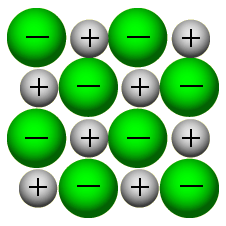
This can be represented at a molecular level using the following diagram:
The positive and negative ions alternate, because like attractions repel and opposites attract. Therefore, when force is applied to an ionic solid, it breaks easily: it is brittle. This is because when the ions are forced to move, they don't slide over each other easily, they get close to a similar charge, causing a force of repulsion and making it break apart easily.

It is important to know the charges of ions seen commonly in this topic. We can deduce the charge based on the number of outer shell (valence) electrons (if it has two, it will lose them, if it has six, it will gain two, etc.)
The following periodic table is a useful guide on the trends:


Section 1 f) Key Words

Anion: Negatively charged ion

Cation: Positively charged ion

Ion: Charged particle, atom with extra electron/s or missing electron/s

Oxidation: Loss of electrons

Reduction: Gain of electrons

Section 1 f) Specification

1.28 describe the formation of ions by the gain or loss of electrons

An ion is formed when an atom loses an electron (It is reduced) or gains an electron (it is oxidised). This change in electron number means the atom has gained a charge. If it has been oxidised, it will become a negative ion: an anion. If it has been reduced, it will become a positive ion: a cation. In ionic bonding, one or more electrons is transferred from one atom to another, turning both into oppositely charged ions which are strongly attracted to one another.

1.29 understand oxidation as the loss of electrons and reduction as the gain of
electrons

OILRIG:
Oxidation
Is
Loss of electrons
Reduction
Is
Gain of electrons

1.30 recall the charges of common ions in this specification

Lithium: Li+
Chlorine: Cl-
Fluorine: F-
Hydrogen: H+
Potassium: K+
Magnesium: Mg2+
Oxygen: O2-

General rule: non-metals are negative, metals are positive


1.31 deduce the charge of an ion from the electronic configuration of the atom
from which the ion is formed

You can look at the outer shell of an atom to determine its ionic charge. If the atom has 2 outer shell electrons, it will lose them and have a charge of 2+. If it has 5 outer shell electrons, it will gain 3, leaving it with a charge of 3-.

1.32 explain, using dot and cross diagrams, the formation of ionic compounds by
electron transfer, limited to combinations of elements from Groups 1, 2, 3
and 5, 6, 7

Ionic bonding is between a metal and a non-metal, the outer shell electrons transferring from the metal to the non metal to give both a full outer shell.

1.33 understand ionic bonding as a strong electrostatic attraction between
oppositely charged ions

The ions become oppositely charged when the electrons are transferred. They experience strong forces of attraction, because opposite charges attract. This forms a strong ionic bond.

1.34 understand that ionic compounds have high melting and boiling points
because of strong electrostatic forces between oppositely charged ions

After transferring electrons, atoms become charged ions which experience strong attraction to opposite charges. This means the electrons are bound by strong electrostatic forces of attraction in this structure:
The strong forces of attraction require a lot of energy to be broken, which is why they have a high melting and boiling point.

1.35 understand the relationship between ionic charge and the melting
point and boiling point of an ionic compound

The bigger the charge, the higher the melting and boiling point as higher charge means stronger forces of attraction.

1.36 describe an ionic crystal as a giant three-dimensional lattice
structure held together by the attraction between oppositely
charged ions

Ionic crystals are held together by the strong forces of attraction between the positively and negatively charged ions. This forms a giant structure, meaning it repeats over and over, and it is a three-dimensional lattice, meaning it is a regular structure that has gaps etc. that allow light to pass through; this is why salt crystals are translucent.

1.37 draw a diagram to represent the positions of the ions in a crystal of
sodium chloride.

Green: Chlorine
White/Grey: Sodium

Wednesday, 14 March 2018

Section 1 e) Key Words

Balanced equation: A chemical equation that is written so the numbers of molecules do not change from one side to the other of the equation.

Concentration: How many molecules of a substance there are in a fixed volume, how dilute it is.

Crucible: A piece of apparatus - a ceramic "pot" that can be used for heating substances to high temperatures. Includes a lid.

Percentage Yield: The percentage of a substance you collect as a percentage of how much was created in a reaction.

State Symbol: Indicates the state of a chemical at room temperature in a reaction (unless otherwise specified), e.g. (g) for gas, (aq) for aqueous. Found in a chemical equation written in the bottom right corner of a molecule.

Yield: The amount of a substance you retrieve from an experiment/chemical reaction

Section 1 e) Summary

This topic is about chemical formulae and equations, how to write and balance them correctly, as well as how to calculate reacting masses.

In a chemical reaction, the number and types of particles should be the same on both sides. But as different molecules require different numbers of each element, the ratio of each molecule created is relative. We must balance the equation to ensure the number of particles, for example:

H2 + O2 --> H2O
The above equation is unbalanced. There are two particles of hydrogen, and two particles of oxygen on the reactants side, but on the products side there are two particles of hydrogen and only one particle of oxygen.
We can remedy this by first changing the particle with the deficit:
H2 + O2 --> 2H2O
Now there are two oxygen particles on either side of the equation. But there are also double the number of hydrogen particles in the products than in the reactants, but this is easily fixed:
2H2 +O2 --> 2H2O
Now there are 4 hydrogen and 2 oxygen on both sides of the equation: it is balanced.

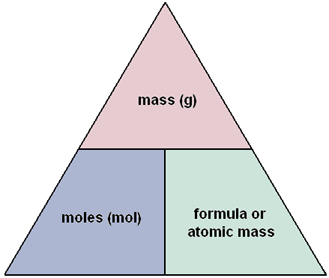
We can use balanced chemical equations to figure out the reacting masses, as it gives us a ratio of the moles, which when multiplied by Mr gives the mass, as shown in this formula triangle:


For example, if we have this balanced equation:
Fe2O3 + 3CO --> 2Fe + 3CO2
And we are told that there is 75 grams of iron oxide, and that we have to calculate what mass of iron can be derived from this with excess carbon monoxide, it can be calculated as follows:

Mr of Iron Oxide: 160
Mass of Iron Oxide: 75 g
75 / 160 = 15/32 mol
Ratio of Fe2O3 : Fe is 1:2
15/32 x 2 = 15/16 mol
Mr of Fe: 56 
56 x 15/16 = 52.5g
52.5 grams of iron can be derived from this reaction 


However, the actual iron we get from this reaction in reality is lower. This is because some may be lost in separation etc., this is called the yield. 
Percentage yield is how much is actually collected of the amount that is expected, and can be calculated with the following equation:

Yield = (mass of product collected x 100) / mass of product calculated

This tells us what percentage of the product is lost in this method, and can be used to compare different methods, as well as give a more accurate prediction of what the actual yield will be. 

For this topic, it is important to know the specifics of two different reactions, which simply demonstrate that you know how to calculate reacting masses and percentage yield:

Metal Oxide
Weigh a crucible with its lid, then place magnesium inside and weigh again, recording the measurements.
Heat it strongly over a roaring bunsen flame, and gently open the lid with tongs momentarily, to allow oxygen to get in without letting the magnesium oxide escape.
Weigh it every so often so you can see how the mass is changing. When the mass stops changing, the reaction is complete.
Record the final mass of the magnesium oxide and crucible, and use the numbers you recorded earlier to determine the mass of magnesium and the mass of oxygen.
Using each element's relative atomic mass, the empirical formula can be determined.

Salt (crystallisation)
Weigh an evaporating basin, then add hydrated copper sulfate and weigh again.
Heat the solution over a bunsen burner, gently stirring to ensure even heating.
Stir until the solution loses colour, indicating all water has been lost.
Weigh again to find the mass of water lost, and also the mass of anhydrous copper sulfate.
Divide mass by Mr of the copper sulfate, and do the same with water.
Simplify this to find the ratio of water to copper sulfate, and round to the nearest whole number,
e.g. CuSO4 ● 5H2O

Section 1 e) Specification

1.21 write word equations and balanced chemical equations to represent the
reactions studied in this specification

Copper + Oxygen --> Copper Oxide
2Cu + O2 --> 2CuO

Carbon + Oxygen --> Carbon Dioxide
C + O2 --> CO2

Hydrogen + Oxygen --> Water (Dihydrogen Monoxide)
2H2 + O2 --> 2H2O

1.22 use the state symbols (s), (l), (g) and (aq) in chemical equations to
represent solids, liquids, gases and aqueous solutions respectively

(s) - the substance is solid at room temp (unless otherwise specified in the question)
(l) - the substance is liquid at room temp (unless otherwise specified in the question)
(g) - the substance is gas at room temp (unless otherwise specified in the question)
(aq) - the substance is dissolved in water

1.23 understand how the formulae of simple compounds can be obtained
experimentally, including metal oxides, water and salts containing water of
crystallisation

Through experiments to remove an element from a compound, the chemical formula can be derived. The reactants are first weighed, and then the mixture is split (You could work out a metal oxide or salt)

Metal Oxide
Weigh a crucible with its lid, then place magnesium inside and weigh again, recording the measurements.
Heat it strongly over a roaring bunsen flame, and gently open the lid with tongs momentarily, to allow oxygen to get in without letting the magnesium oxide escape.
Weigh it every so often so you can see how the mass is changing. When the mass stops changing, the reaction is complete.
Record the final mass of the magnesium oxide and crucible, and use the numbers you recorded earlier to determine the mass of magnesium and the mass of oxygen.
Using each element's relative atomic mass, the empirical formula can be determined.

Salt (crystallisation)
Weigh an evaporating basin, then add hydrated copper sulfate and weigh again.
Heat the solution over a bunsen burner, gently stirring to ensure even heating.
Stir until the solution loses colour, indicating all water has been lost.
Weigh again to find the mass of water lost, and also the mass of anhydrous copper sulfate.
Divide mass by Mr of the copper sulfate, and do the same with water.
Simplify this to find the ratio of water to copper sulfate, and round to the nearest whole number,
e.g. CuSO4 ● 5H2O

1.24 calculate empirical and molecular formulae from experimental data

By weighing compounds, then extracting an element from them through a chemical reaction and recording the change in mass, then making these masses into percentages and dividing by Ar, we can find the number of atoms of it in a molecule. Empirical and molecular formulae of compounds and elements can be found this way.

1.25 calculate reacting masses using experimental data and chemical equations

The mass of the reactants is always equal to the mass of the products. Using this principle, applied to equations, we can calculate the different masses.

1.26 calculate percentage yield

(yield retrieved  x 100 )/ full potential yield = percentage yield

The expected or potential yield can be calculated in a reacting mass calculation, however we are not always able to recover the full yield. The amount we retrieve can be calculated as a percentage of the full potential yield using the above equation.

1.27 carry out mole calculations using volumes and molar concentrations.

Using the above formula triangle, the moles, volume and concentration (molar volume) can be calculated in a chemical equation.

Saturday, 24 February 2018

Section 1 d) Summary

Relative atomic mass (Ar) is the mass of an atom, relative to Carbon, which has an Ar of 12. This is because of the tiny size of atoms, measuring in fractions of a gram would be extremely impractical.
Relative formula mass (Mr) is the total relative mass of a molecule. It is the Ar of each atom in a molecule added together. (e.g. CO2 would be 1 x 12, because there is one carbon, plus 2 x 16, because there are two oxygens, adding to a Mr of 44)

Mr can be used to calculate the mass of a substance that can be obtained from a chemical reaction, or how much of a substance is necessary to neutralise another substance.
This formula triangle is useful in calculating masses:

When the Mr of a substance is equal to the number of grams there are of it, that is one mole. A mole is 6.022 x 10^23 particles. This is called Avagadro's number, or Avagadro's constant.
A mole of gas at room temperature and pressure always takes up 24 dm^3, or 24000 cm^3. 

Thursday, 22 February 2018

Section 1 d) Key Words

Ar/Relative Atomic Mass: The mass of a single atom relative to Carbon 12

Avagadro's Number: The number of particles of a substance in 1 mole of it: 6.022 x 10^23

Molar Volume: The volume of space 1 mole of any gas takes up at room temperature and pressure: 24dm^3 or 24000cm^3

Mole: The number of particles it takes for Mr to equal mass in grams. Avagadro's number of particles are in 1 mole.

Mr/Relative Formula Mass: The mass of a molecule relative to carbon 12.

Section 1 d) Specification

1.16 calculate relative formula masses (Mr) from relative atomic masses (Ar)

From the chemical formula of a compound, the Mr can be found by adding the individual relative atomic masses of each atom.
e.g. CO2
C = 12, O = 16
12 + (2 x 16) = 44

1.17 understand the use of the term mole to represent the amount of substance

A mole is the amount of a substance with the same number of molecules as Carbon 12 at a mass of 0.012kg (12g). Otherwise defined as having 6.022 x 10^23 molecules of it.

1.18 understand the term mole as the Avogadro number of particles
(atoms, molecules, formulae, ions or electrons) in a substance

Avagadro's number is how many particles of a substance there must be for its mass in grams to be equal to its relative atomic mass. Avagadro's number is 6.02214154 x 10^23, but at GCSE level we shorten it to 6.022 x 10^23 unless otherwise specified.

1.19 carry out mole calculations using relative atomic mass (Ar) and relative
formula mass (Mr)

The above formula triangle can be used to calculate different parts of a chemical formula.
Examples:

2Ca + O2 --> 2CaO
2mol 1mol    2mol
1 mole of any substance contains the same number of particles.
If we have 5g of Calcium, what mass of Calcium Oxide will we get?
Mass of Ca = 5g       Mr of Ca = 40       5 / 40 = 1 / 8 moles
The ratio of Ca:CaO is 1:1, so there is the same number of moles.
1/8 mol of CaO must be multiplied by its Mr to find the mass
Mr of CaO = 56      56 x 1/8 = 7
There are 7 grams of CaO from 5g Ca.

CuSO4 + Zn --> ZnSO4 + Cu
1mol     1mol     1mol      1mol
If we have 1.5g Zinc,  what mass of Copper will we get?
1.5g / 65 = 3/130 mol
ratio 1:1 so same number of moles
Mr of copper = 63.5
3/130 x 63.5 = 1.47 g

2Fe + 3Cl2 --> 2FeCl3
How much Chlorine is needed to react with 20g of Iron?
20 / 56 = 5/14 mol
ratio is 2:3 so we first divide by 2 to get 5/28
then multiply by 3 to get 15/28
we then find the Mr of Cl2     35.5 x 2 = 71
15/28 x 71 = 38 1/28 g

1.20 understand the term molar volume of a gas and use its values
(24 dm^3 and 24,000 cm^3) at room temperature and pressure (rtp) in
calculations.

1 mole of any gas takes up the volume of 24dm^3 at room temperature and Earth's atmospheric pressure. We can use this in gas calculations to calculate gas volumes, or use it the other way around and find how many moles there are based on its volume. 

Wednesday, 21 February 2018

Section 1 c) Summary

Atoms are made up of a central nucleus, which has a relative positive charge due to its protons. It also contains neutrons. These make up the entire relative mass of the atom.
This is orbited by negatively charged electrons, which are attracted to the positive nucleus. These electrons make up shells, which have capacity: 2,8,8,8,8,8,8.

An atom has equal numbers of protons and electrons, resulting in no overall charge. Electrons can be transferred to other particles, however, or gained from them. This results in the atom gaining a charge and becoming an ion. A negatively charged ion is called a cation and a positively charged ion is called an anion.

When atoms have the same number of protons but a different number of neutrons, they are called isotopes.

All chemical elements are organised in the periodic table.

It is organised in order of atomic number. It fits into different groups and periods based off properties and characteristics. The properties and reactivity of an element can be predicted by the surrounding elements in the table.
Periods are the rows, Groups are the columns.
The periods can tell us the number of shells each atom has, while the groups tell us the number of outer shell electrons they have.
The basic electronic capacity of the shells is 2, 8, 8, 8

Section 1 c) Key Words

Atom: The smallest chemical particle. Made up of positively charged central nucleus (protons and neutrons) and shells of negatively charged electrons.

Atomic Number: The number of protons in an atom

Electron: Negatively charged subatomic particle with a relative mass of 0. Orbits the nucleus in shells and can be transferred to other atoms to form charged ions.

Group: The vertical organisation of elements in the periodic table. From left to right, there are 8 groups: 1, 2, 3, 4, 5, 6, 7, 0

Ion: A charged chemical particle, an atom that has lost or gained electrons.

Isotope: Atoms with the same number of protons but different numbers of neutrons

Mass Number: Number of protons + Number of neutrons

Nucleus: The central part of an atom comprised of protons and neutrons. Positively charged.

Neutron: A subatomic particle without charge and relative mass 1. Found in the nucleus.

Period: The horizontal organisation in the periodic table, numbers increasing top to bottom.

Periodic Table: A way of organising the chemical elements by atomic number, with patterns relating to reactivity and other properties.

Proton: A positively charged subatomic particle with a relative mass of 1. Found in the nucleus.

Relative Atomic Mass: The mass of an atom, relative to carbon 12.

Valence Electron(s): The electrons found in the outer electron shell.  

Section 3 a) Specification

3.1 explain the terms homologous series, hydrocarbon, saturated, unsaturated, general formula and isomerism. A homologous series is a grou...