Showing posts with label Specification. Show all posts

Wednesday, 18 April 2018

Section 3 a) Specification

3.1 explain the terms homologous series, hydrocarbon, saturated, unsaturated, general formula and isomerism.

A homologous series is a group of compounds with the same general formula and similar chemical properties.
A hydrocarbon is a compound made up of only hydrogen and carbon particles.
Saturated means that a compound is made up of only single bonds, it has no double bonds. Alkanes are a homologous series of saturated hydrocarbons.
Unsaturated means that a compound includes double bonds. Alkenes are a homologous series of unsaturated hydrocarbons.
A general formula is a type of empirical formula that represents of all of the members of a homologous series.
Isomers are molecules with the same chemical formula but different structures (e.g. diamond and graphite are both carbon, but are very different because they are isomers)


Section 3 Specification

a) Introduction

3.1 explain the terms homologous series, hydrocarbon, saturated, unsaturated, general formula and isomerism.


b) Alkanes 

3.2 recall that alkanes have the general formula CnH2n+2

3.3 draw displayed formulae for alkanes with up to five carbon atoms in a molecule, and name the straight-chain isomers

3.4 recall the products of the complete and incomplete combustion of alkanes 3.5 describe the substitution reaction of methane with bromine to form bromomethane in the presence of UV light.


c) Alkenes 

3.6 recall that alkenes have the general formula CnH2n

3.7 draw displayed formulae for alkenes with up to four carbon atoms in a molecule, and name the straight-chain isomers (knowledge of cis- and transisomers is not required)

3.8 describe the addition reaction of alkenes with bromine, including the decolourising of bromine water as a test for alkenes.


d) Ethanol 

3.9 describe the manufacture of ethanol by passing ethene and steam over a phosphoric acid catalyst at a temperature of about 300°C and a pressure of about 60–70 atm

3.10 describe the manufacture of ethanol by the fermentation of sugars, for example glucose, at a temperature of about 30°C

3.11 evaluate the factors relevant to the choice of method used in the manufacture of ethanol, for example the relative availability of sugar cane and crude oil

3.12 describe the dehydration of ethanol to ethene, using aluminium oxide.

Section 2 g) Specfication

2.37 describe tests for the cations:
i Li+, Na+, K+, Ca2+ using flame tests
ii NH4 +, using sodium hydroxide solution and identifying the ammonia evolved
iii Cu2+, Fe2+ and Fe3+, using sodium hydroxide solution


2.38 describe tests for the anions:
i Cl- , Br- and I- , using dilute nitric acid and silver nitrate solution
ii SO4 2- , using dilute hydrochloric acid and barium chloride solution
iii CO3 2- , using dilute hydrochloric acid and identifying the carbon dioxide evolved


2.39 describe tests for the gases:
i hydrogen
ii oxygen
iii carbon dioxide
iv ammonia
v chlorine.


Saturday, 7 April 2018

Section 2 f) Specification

2.29 understand that metals can be arranged in a reactivity series based on the reactions of the metals and their compounds: potassium, sodium, lithium, calcium, magnesium, aluminium, zinc, iron, copper, silver and gold

Some metals are more reactive than others, based on their chemical compositions. More reactive metals will displace less reactive metals in a compound, and they react more strongly. From reactions, we can determine the reactivity series (from most to least reactive):

Potassium K
Sodium Na
Lithium Li
Calcium Ca
Magnesium Mg
Aluminium Al
Zinc Zn
Iron Fe
Copper Cu
Silver Ag
Gold Au

2.30 describe how reactions with water and dilute acids can be used to deduce the following order of reactivity: potassium, sodium, lithium, calcium, magnesium, zinc, iron and copper

Potassium, sodium, and lithium are alkali metals, therefore their reactivity series is easily determined by reacting them with cold water. Calcium also reacts with water, but less so. Magnesium, zinc, and iron will only react with cold water very slowly, but will react with acids (e.g. hydrochloric acid) with varying degrees of intensities. 
Copper will not react with either an acid or water.
The more vigorous the reaction, the more reactive the metal.

2.31 deduce the position of a metal within the reactivity series using displacement reactions between metals and their oxides, and between metals and their salts in aqueous solutions

To carry out a reaction to determine reactivity series, dissolve a metal oxide or metal salt in water, then add another metal. If there is a reaction, the metal you introduced is more reactive. If there is no reaction, it is less reactive. This can be done multiple times with different metals to determine reactivity series.

2.32 understand oxidation and reduction as the addition and removal of oxygen respectively

OILRIG says Oxidation Is Loss of electrons and Reduction Is Gain of electrons, but it can also be in reference to loss or gain of an oxygen ion, as they are positively charged; they have more protons than electrons. Oxidation is gain of oxygen ions and reduction is loss of oxygen ions. This is easily memorable as 'oxidation' is rooted from the word oxygen.

2.33 understand the terms redox, oxidising agent, reducing agent

Redox means a reaction involving molecules that are reduced and molecules that are oxidised.
An oxidising agent is a less reactive metal in a compound that allows the other metal to be oxidised.
A reducing agent is a more reactive metal that reduces the other metal.

2.34 describe the conditions under which iron rusts

Under conditions where there is moisture and air; it requires both oxygen and water to rust.

2.35 describe how the rusting of iron may be prevented by grease, oil, paint, plastic and galvanising

Grease, oil, paint or plastic creates a layer between the iron and air and water. It repels water and doesn't allow air in.
Galvanising is a technique of coating iron with zinc, a more reactive metal. The air and water react with the zinc instead of the iron, and preventing the iron from coming into contact with the air.

2.36 understand the sacrificial protection of iron in terms of the reactivity series.

Sacrificial protection means a more reactive metal is made to coat a less reactive one, it then reacts with the air and water instead of the iron.

Thursday, 5 April 2018

Section 2 e) Specification

2.25 describe the reactions of dilute hydrochloric and dilute sulfuric acids with magnesium, aluminium, zinc and iron

The rule "MASH" tells us that when a metal reacts with an acid, a salt will be produced, as well as hydrogen.

Metal + Acid --> Salt + Hydrogen

e.g.

Mg(s) + 2HCl(aq) --> MgCl2 + H2

2.26 describe the combustion of hydrogen

The combustion of hydrogen is its reaction with oxygen. It is exothermic, so a lot of energy is produced, as well as pure water.

2H2 + O2 --> 2H2O

2.27 describe the use of anhydrous copper(II) sulfate in the chemical test for water

If anhydrous copper sulphate changes from white to blue, it has become hydrous copper sulphate and it contains water.

2.28 describe a physical test to show whether water is pure.

Heat the water until it boils, with a thermometer. If it boiled at 100℃ exactly, it is pure water.

Friday, 30 March 2018

Section 2 d) Specification

2.16 recall the gases present in air and their approximate percentage by volume

Oxygen - 21%
Nitrogen - 78%
Argon - 0.9%
Other (carbon dioxide, water vapour, etc.) - >0.1%

2.17 explain how experiments involving the reactions of elements such as copper, iron and phosphorus with air can be used to investigate the percentage by volume of oxygen in air

If you have a known volume of air, then remove the oxygen by reacting it with an excess of another element (copper, iron, phosphorus) to create a solid, the volume of gas will change. This change can then be used to calculate the percentage of oxygen in the air. This can be done multiple times, and an average found, to increase the accuracy of the results.

2.18 describe the laboratory preparation of oxygen from hydrogen peroxide, using manganese(IV) oxide as a catalyst

Hydrogen peroxide can be decomposed simply by heating with a catalyst - Manganese oxide
Hydrogen peroxide --> Oxygen + Water
The oxygen bubbles created can be collected using the downwards displacement method.

2.19 describe the reactions of magnesium, carbon and sulfur with oxygen in air, and the acid-base character of the oxides produced

Magnesium burns in air, reacting with oxygen, to form magnesium oxide, a basic substance, as it is a metal oxide.

Magnesium + Oxygen --> Magnesium Oxide

Carbon and sulphur are both non-metals, that react with air, giving out heat and light, to form acidic non-metal oxides.

Carbon + Oxygen --> Carbon dioxide

Sulphur + Oxygen --> Sulphur dioxide

2.20 describe the laboratory preparation of carbon dioxide from calcium carbonate and dilute hydrochloric acid

Hydrochloric acid + Calcium carbonate --> Carbon dioxide + Calcium chloride + Water

HCl(aq) + CaCO3(s) --> CO2(g) +CaCl2(s) + H2O(l)

Calcium carbonate could be used as marble or limestone, and dropped into a sealed flask of dilute hydrochloric acid in small pieces. A delivery tube could be placed in the end of the bung to allow for the gas to be collected in the downwards displacement method. 

2.21 describe the formation of carbon dioxide from the thermal decomposition of metal carbonates such as copper(II) carbonate

Copper (II) Carbonate --> Carbon Dioxide + Copper Oxide
CuCO3 --> CO2 + CuO

2.22 describe the properties of carbon dioxide, limited to its solubility and density

Carbon dioxide is a relatively dense gas, it is denser than air. It is water-soluble at high pressure, so when bubbled through water carbonic acid can be formed, and it turns lime water cloudy when dissolved.

2.23 explain the use of carbon dioxide in carbonating drinks and in fire extinguishers, in terms of its solubility and density

When carbon dioxide is dissolved into a liquid at a high pressure, it carbonates it. This reaction is reversible, so this means that when it is returned to atmospheric pressure, bubbles of carbon dioxide form again, and this is how we get fizzy drinks.

Carbon dioxide is used in fire extinguishers because it is denser than air, and is therefore good at smothering fires and preventing oxygen from reaching them. The carbon dioxide sinks over the fire in a blanket and stops oxygen from reaching it, which is necessary for combustion.

2.24 understand that carbon dioxide is a greenhouse gas and may contribute to climate change.

Carbon dioxide is a greenhouse gas, meaning that it traps the sun's energy in the atmosphere, creating the enhanced greenhouse effect with excess. This excess heat that is not able to escape the Earth is a major cause of climate change. 

Wednesday, 28 March 2018

Section 2 c) Specification

2.9 recall the colours and physical states of the elements at room temperature

Fluorine, F : Pale yellow gas
Chlorine, Cl : Pale green gas
Bromine, Br : Orange liquid
Iodine, I : Purple solid
Astatine, At : Black solid

2.10 make predictions about the properties of other halogens in this group

Based on the information we know about fluorine, chlorine and bromine we can assume that as we travel down the group

  • Reactivity decreases
  • Melting and boiling point increase
  • Elements get darker in colour
They all have antimicrobial properties in small doses, but are toxic in large doses.


2.11 understand the difference between hydrogen chloride gas and hydrochloric acid

Hydrogen chloride gas is the product of the reaction between hydrogen and chlorine. This can be dissolved in water to make it aqueous, causing the ions to be dissociated - detatched. This creates Cl - ions, as well as acidic H + ions, creating hydrochloric acid.

2.12 explain, in terms of dissociation, why hydrogen chloride is acidic in water but not in methylbenzene

Water is a polar substance, and methylbenzene is non-polar. Polar substances cause ionic bonding to be separated (dissociated), as the anions are attracted to the positive poles of the molecules, and the cations are attracted to the negative poles. This causes them to split. Non-polar substances aren't able to dissociate compounds in this way.

2.13 describe the relative reactivities of the elements in Group 7

They become less reactive as you go down the group, so larger elements are less reactive because the force of attraction between the nucleus and the valence electrons is weaker, so it is less able to attract another electron.

2.14 describe experiments to demonstrate that a more reactive halogen will displace a less reactive halogen from a solution of one of its salts

A more reactive halogen will displace a less reactive halogen bonded as a salt. For example, a sodium halide solution could be created for each of the halogens (potassium fluoride, potassium chloride, potassium bromide, etc.), then reacted with a halide solution, to discover the reactivity series:

Methylbenzene turns purple in presence of iodine, and yellow in presence of bromine. It can be added as a layer of indicator, showing us which substances are present (when bonded, does not affect indicator).
This series of experiments shows us that chlorine is the most reactive of these halogens, and iodine is the least, as chlorine water had the most displacements and iodine the least.

2.15 understand these displacement reactions as redox reactions.

Redox reactions are reactions that involve the loss and gain of electrons:
Oxidation
Is
Loss of electrons
Reduction
Is
Gain of electrons

When one more reactive halogen displaces a less reactive halogen, the more reactive halogen is reduced, and the less reactive one is oxidised.

As you can see in the above equations, more reactive chlorine reacts with sodium bromide. Bromine is less reactive than chlorine, so it displaces it. In this process, the bromine loses an electron and bonds with itself to form diatomic molecules. The chlorine molecules bond with sodium, and gain an electron, reducing them and giving them a negative charge.

Section 2 b) Specification

2.6 describe the reactions of these elements with water and understand that the reactions provide a basis for their recognition as a family of elements

Lithium, Li: Fizzes vigorously, moves around the surface of the water.
Sodium, Na: Fizzes violently, moves quickly on the water, forms a ball shape & yellow sparks.
Potassium, K: Produces a purple flame, violently moves around the surface and pops with the force of hydrogen production.

These elements each react vigorously with cold water (due to their similar electronic configurations), an indication that they are the most reactive group of elements. They produce hydrogen gas as well as a metal hydroxide.

2.7 describe the relative reactivities of the elements in Group 1

The reactions start small at the top of the table, but gradually increase in violence as you travel down the table as the atoms are bigger and less able to hold onto their valence electron. Francium reacts extremely violently and explosively when reacting with cold water, whereas lithium just fizzes.

2.8 explain the relative reactivities of the elements in Group 1 in terms of distance between the outer electrons and the nucleus.

The elements get more reactive as you go down the group because the increase in distance between the valence electron and nucleus is increased due to increased number of shells, resulting in a weaker force of electrostatic attraction and a more reactive element.

Monday, 26 March 2018

Section 2 a) Specification

2.1 understand the terms group and period 

The period is the row that the element is in, it indicates how many shells of electrons it has.

The group is the column in which the element can be found. It indicates how many valence electrons the element has.

2.2 recall the positions of metals and non-metals in the Periodic Table 

The non-metals lie to the right of the red line, and metals to the left:


2.3 explain the classification of elements as metals or non-metals on the basis of their electrical conductivity and the acid-base character of their oxides 

Metals are characterised by their conductive abilities, and that their oxides dissolve in water to form bases.
Non-metals are insulators (except for carbon), and their oxides dissolve in water to form acids.

2.4 understand why elements in the same group of the Periodic Table have similar chemical properties 

Elements in the same group have the same number of valence electrons: they have to gain or lose the same number of electrons. This means their chemical properties are similar, but as the periods change the characteristic gradually changes. (e.g. reactivity increases, the colour gradually darkens, etc.)

2.5 understand that the noble gases (Group 0) are a family of inert gases and explain their lack of reactivity in terms of their electronic configurations.

Noble gases have full outer shells, so they are unreactive. Reactive elements are unstable, and react to achieve a full outer shell, but because noble gases have full outer shells, they don't have electrons to gain or lose.

Section 2 Specification

a) The Periodic Table 

2.1 understand the terms group and period

2.2 recall the positions of metals and non-metals in the Periodic Table

2.3 explain the classification of elements as metals or non-metals on the basis of their electrical conductivity and the acid-base character of their oxides

2.4 understand why elements in the same group of the Periodic Table have similar chemical properties

2.5 understand that the noble gases (Group 0) are a family of inert gases and explain their lack of reactivity in terms of their electronic configurations.


b) Group 1 elements — lithium, sodium and potassium 

2.6 describe the reactions of these elements with water and understand that the reactions provide a basis for their recognition as a family of elements

2.7 describe the relative reactivities of the elements in Group 1

2.8 explain the relative reactivities of the elements in Group 1 in terms of distance between the outer electrons and the nucleus.


c) Group 7 elements — chlorine, bromine and iodine 

2.9 recall the colours and physical states of the elements at room temperature

2.10 make predictions about the properties of other halogens in this group

2.11 understand the difference between hydrogen chloride gas and hydrochloric acid

2.12 explain, in terms of dissociation, why hydrogen chloride is acidic in water but not in methylbenzene

2.13 describe the relative reactivities of the elements in Group 7

2.14 describe experiments to demonstrate that a more reactive halogen will displace a less reactive halogen from a solution of one of its salts

2.15 understand these displacement reactions as redox reactions.


d) Oxygen and oxides 

2.16 recall the gases present in air and their approximate percentage by volume

2.17 explain how experiments involving the reactions of elements such as copper, iron and phosphorus with air can be used to investigate the percentage by volume of oxygen in air

2.18 describe the laboratory preparation of oxygen from hydrogen peroxide, using manganese(IV) oxide as a catalyst

2.19 describe the reactions of magnesium, carbon and sulfur with oxygen in air, and the acid-base character of the oxides produced

2.20 describe the laboratory preparation of carbon dioxide from calcium carbonate and dilute hydrochloric acid

2.21 describe the formation of carbon dioxide from the thermal decomposition of metal carbonates such as copper(II) carbonate

2.22 describe the properties of carbon dioxide, limited to its solubility and density

2.23 explain the use of carbon dioxide in carbonating drinks and in fire extinguishers, in terms of its solubility and density

2.24 understand that carbon dioxide is a greenhouse gas and may contribute to climate change.


e) Hydrogen and water

2.25 describe the reactions of dilute hydrochloric and dilute sulfuric acids with magnesium, aluminium, zinc and iron

2.26 describe the combustion of hydrogen

2.27 describe the use of anhydrous copper(II) sulfate in the chemical test for water

2.28 describe a physical test to show whether water is pure.


f) Reactivity series 

2.29 understand that metals can be arranged in a reactivity series based on the reactions of the metals and their compounds: potassium, sodium, lithium, calcium, magnesium, aluminium, zinc, iron, copper, silver and gold

2.30 describe how reactions with water and dilute acids can be used to deduce the following order of reactivity: potassium, sodium, lithium, calcium, magnesium, zinc, iron and copper

2.31 deduce the position of a metal within the reactivity series using displacement reactions between metals and their oxides, and between metals and their salts in aqueous solutions

2.32 understand oxidation and reduction as the addition and removal of oxygen respectively

2.33 understand the terms redox, oxidising agent, reducing agent

2.34 describe the conditions under which iron rusts

2.35 describe how the rusting of iron may be prevented by grease, oil, paint, plastic and galvanising

2.36 understand the sacrificial protection of iron in terms of the reactivity series.


g) Tests for ions and gases 

2.37 describe tests for the cations:
i Li+, Na+, K+, Ca2+ using flame tests
ii NH4 +, using sodium hydroxide solution and identifying the ammonia evolved
iii Cu2+, Fe2+ and Fe3+, using sodium hydroxide solution

2.38 describe tests for the anions:
i Cl- , Br- and I- , using dilute nitric acid and silver nitrate solution
ii SO4 2- , using dilute hydrochloric acid and barium chloride solution
iii CO3 2- , using dilute hydrochloric acid and identifying the carbon dioxide evolved

2.39 describe tests for the gases:
i hydrogen
ii oxygen
iii carbon dioxide
iv ammonia
v chlorine.


Saturday, 24 March 2018

Section 1 i) Specification

1.48 understand that an electric current is a flow of electrons or ions

Electric current is the movement of charged particles in a sort of stream. Usually it is in reference to electrons, but free ions can also conduct electricity/carry charge, as they are charged particles.

1.49 understand why covalent compounds do not conduct electricity

In covalent compounds, there are no free charged particles (no delocalised electrons, no ions) available to carry charge.

1.50 understand why ionic compounds conduct electricity only when molten or in
solution

Ionic compounds, when solid, do not conduct electricity. This is because the ions are not free to move; they are held in place by strong ionic bonding. When molten or aqueous, the ions become free and can then carry electrical charge.

1.51 describe experiments to distinguish between electrolytes and nonelectrolytes

Make a simple circuit involving a buzzer or a lightbulb, then, in series with the chosen component, place a beaker containing the liquid in question with electrodes attached into the circuit. If the component works, it is an electrolyte, because it allowed current to flow through. If the component does not work, it is a nonelectrolyte as it has broken the connection of the circuit.

1.52 understand that electrolysis involves the formation of new substances when
ionic compounds conduct electricity

Electrolysis is a process designed to separate ionic compounds and re-form them back into their individual elements.

1.53 describe experiments to investigate electrolysis, using inert electrodes, of
molten salts such as lead(II) bromide and predict the products


  1. Place carbon electrodes into a beaker containing lead bromide, so they are submerged. 
  2. Hook the electrodes up to a cell and allow current to flow for some time.
  3. At the cathode (negative electrode), positive metal ions will be reduced, in this case lead will form. 
  4. At the anode (positive electrode), negative non-metal ions will be attracted and oxidised, in this case bromine will form. 

1.54 describe experiments to investigate electrolysis, using inert
electrodes, of aqueous solutions such as sodium chloride, copper(II)
sulfate and dilute sulfuric acid and predict the products

Sodium chloride
  1. Place carbon electrodes into a beaker containing lead bromide, so they are submerged. 
  2. Hook the electrodes up to a cell and allow current to flow for some time.
  3. At the cathode (negative electrode), positive hydrogen ions will be reduced, and bubbles of hydrogen gas will form
  4. At the anode (positive electrode), negative halide ions will be attracted and oxidised, in this case chlorine will form. 
Copper (II) sulphate
  1. Place carbon electrodes into a beaker containing lead bromide, so they are submerged. 
  2. Hook the electrodes up to a cell and allow current to flow for some time.
  3. At the cathode (negative electrode), positive copper ions will be reduced, and copper will coat the electrode.
  4. At the anode (positive electrode), negative hydroxide ions will be attracted and oxidised, and bubbles of oxygen gas will form. 

Dilute sulphuric acid
  1. Place carbon electrodes into a beaker containing lead bromide, so they are submerged. 
  2. Hook the electrodes up to a cell and allow current to flow for some time.
  3. At the cathode (negative electrode), positive hydrogen ions will be reduced, and bubbles of hydrogen gas will form
  4. At the anode (positive electrode), negative hydroxide ions will be attracted and oxidised, and bubbles of oxygen gas will form.
1.55 write ionic half-equations representing the reactions at the electrodes during
electrolysis

Lead bromide
Cathode: Pb2+ + 2e- --> Pb
Anode: 2Br- --> Br2 + 2e-

Sodium chloride
Cathode: 2H+ + 2e- --> H2
Anode: 2Cl- --> Cl2 + 2e-

Copper (II) sulphate
Cathode: Cu2+ + 2e- --> Cu
Anode: 4OH- --> O2 + H2O + 4e-

Dilute Sulphuric acid
Cathode: 2H+ + 2e- --> H2
Anode: 4OH- --> O2 +H2O + 4e-

1.56 recall that one faraday represents one mole of electrons

One faraday = 96500 coulombs = 1 mole of electrons

1.57 calculate the amounts of the products of the electrolysis of molten
salts and aqueous solutions.

If a current of 1.5A is passed through lead bromide for 1 hour, how much lead will form?
Half equation: Pb2+ + 2e- --> Pb
Coulombs = Current (in amperes) x Time (in seconds) = 5400 C

Conversion into moles of electrons:
1 mole = 1 faraday = 96500 coulombs
5400 / 96500 = 54/965 mol

There are 2 moles of electrons for every mole of lead, so divide by 2 = 27/965 mol
Then multiply by Mr to find mass 27/965 x 207 = 5.79 g 


If a current of 2A is passed through sodium chloride for 2 hours, what volume of chlorine will form?
Half equation: 2Cl- --> Cl2 + 2e-
Q = I T = 14400 C

1 mole = 1 faraday - 96500 C
14400 / 96500 = 144/965 mol

2 electrons per atom, so divide by 2 = 72/965 mol
Then multiply by 24 000 to find volume in cm3 72/965 x 24000 = 1790.67 cm3


If a current of 4.2A is passed through copper (II) sulphate for 45 minutes, what mass of copper will be formed?
Half equation: Cu2+ + 2e- --> Cu
Q = I T = 11340C

11340 / 96500 = 567/4825 mol

2 electrons per atom, so divide by 2 = 567/9650 mol
Then multiply by Mr 567/9650 x 63.5 = 3.73 g


If a current of 0.2A is passed through dilute sulphuric acid for 5 hours and 45 minutes, what volume of hydrogen is produced?
Half equation: 2H+ + 2e- --> H2
Q = I T = (5 x 60 + 45) x 60 x 0.2 = 4140C

4140 / 96500 = 207/4825 mol

2 moles of electrons per mole of hydrogen, so divide by 2 = 207/9650 mol
Then multiply by 24 000 to get the volume in cubic centimetres 207/9650 x 24 000 = 514.82 cm3

Section 1 h) Specification

1.46 understand that a metal can be described as a giant structure of positive
ions surrounded by a sea of delocalised electrons

In metallic bonding, the positive ions are regularly arranged in a giant structure. These are surrounded by a sea of delocalised electrons, without which the cations would repel each other; the attraction between the positive ions and electrons holds the structure together.

1.47 explain the electrical conductivity and malleability of a metal in terms of its
structure and bonding.

Metal is a good conductor of both electricity and heat. This is because of its sea of delocalised electrons that are free to move and carry charge.
Metal is malleable and ductile because of its giant structure. It is in layers that can slip past one another when force is applied, as opposed to snapping. 

Friday, 23 March 2018

Section 1 g) Specification

1.38 describe the formation of a covalent bond by the sharing of a pair of
electrons between two atoms

A covalent bond is formed between two non-metals and involves the atoms sharing one or more pairs of electrons


1.39 understand covalent bonding as a strong attraction between the bonding
pair of electrons and the nuclei of the atoms involved in the bond

In a covalent bond, the nucleus of each atom is attracted to the other atom's outer shell electron(s).

1.40 explain, using dot and cross diagrams, the formation of covalent compounds
by electron sharing for the following substances:
i hydrogen
ii chlorine
iii hydrogen chloride
iv water
v methane
vi ammonia
vii oxygen
viii nitrogen
ix carbon dioxide
x ethane
xi ethene


1.41 understand that substances with simple molecular structures are gases or
liquids, or solids with low melting points

Simple covalent compounds have strong bonds, but very weak intermolecular forces. These don't require much energy to break, leading to low melting and boiling points. As a result, most simple covalent compounds are gas or liquid at room temperature.

1.42 explain why substances with simple molecular structures have low melting
and boiling points in terms of the relatively weak forces between the
molecules

There aren't very strong forces of attraction between covalent molecules, they have weak intermolecular forces that are easily broken; they don't require much energy to break. This means that they have low melting and boiling points.

1.43 explain the high melting and boiling points of substances with giant covalent
structures in terms of the breaking of many strong covalent bonds

In giant covalent structures, each atom is bonded to another with by strong covalent bonds. These are not easily broken, they require a lot of energy to break. Additionally, in a giant structure there are so many bonds to break that it requires even more. This results in very high melting and boiling points.

1.44 draw diagrams representing the positions of the atoms in diamond
and graphite


1.45 explain how the uses of diamond and graphite depend on their
structures, limited to graphite as a lubricant and diamond in cutting.

In diamond, the carbon atoms are arranged in a tetrahedronal structure, each atom with four strong covalent bonds. This makes it very hard, with a very high melting and boiling point. It has lots of very strong bonds. Its giant structure means that it forms in crystals that reflect light and let it pass through. It is so hard that its use in industrial saws etc. is ideal, it can cut through almost anything.

Graphite is arranged in layers held together by weak intermolecular forces. This means that when force is applied, the layers slide over each other easily, making graphite a good lubricant.

Both diamond and graphite are allotropes of carbon, but buckminsterfullerene is another one, it's ball shaped, made of 60 carbon atoms, and used for lubrication, drug administration, and in catalysts. 

Section 1 f) Specification

1.28 describe the formation of ions by the gain or loss of electrons

An ion is formed when an atom loses an electron (It is reduced) or gains an electron (it is oxidised). This change in electron number means the atom has gained a charge. If it has been oxidised, it will become a negative ion: an anion. If it has been reduced, it will become a positive ion: a cation. In ionic bonding, one or more electrons is transferred from one atom to another, turning both into oppositely charged ions which are strongly attracted to one another.

1.29 understand oxidation as the loss of electrons and reduction as the gain of
electrons

OILRIG:
Oxidation
Is
Loss of electrons
Reduction
Is
Gain of electrons

1.30 recall the charges of common ions in this specification

Lithium: Li+
Chlorine: Cl-
Fluorine: F-
Hydrogen: H+
Potassium: K+
Magnesium: Mg2+
Oxygen: O2-

General rule: non-metals are negative, metals are positive


1.31 deduce the charge of an ion from the electronic configuration of the atom
from which the ion is formed

You can look at the outer shell of an atom to determine its ionic charge. If the atom has 2 outer shell electrons, it will lose them and have a charge of 2+. If it has 5 outer shell electrons, it will gain 3, leaving it with a charge of 3-.

1.32 explain, using dot and cross diagrams, the formation of ionic compounds by
electron transfer, limited to combinations of elements from Groups 1, 2, 3
and 5, 6, 7

Ionic bonding is between a metal and a non-metal, the outer shell electrons transferring from the metal to the non metal to give both a full outer shell.

1.33 understand ionic bonding as a strong electrostatic attraction between
oppositely charged ions

The ions become oppositely charged when the electrons are transferred. They experience strong forces of attraction, because opposite charges attract. This forms a strong ionic bond.

1.34 understand that ionic compounds have high melting and boiling points
because of strong electrostatic forces between oppositely charged ions

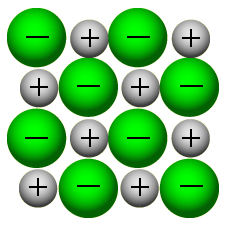
After transferring electrons, atoms become charged ions which experience strong attraction to opposite charges. This means the electrons are bound by strong electrostatic forces of attraction in this structure:
The strong forces of attraction require a lot of energy to be broken, which is why they have a high melting and boiling point.

1.35 understand the relationship between ionic charge and the melting
point and boiling point of an ionic compound

The bigger the charge, the higher the melting and boiling point as higher charge means stronger forces of attraction.

1.36 describe an ionic crystal as a giant three-dimensional lattice
structure held together by the attraction between oppositely
charged ions

Ionic crystals are held together by the strong forces of attraction between the positively and negatively charged ions. This forms a giant structure, meaning it repeats over and over, and it is a three-dimensional lattice, meaning it is a regular structure that has gaps etc. that allow light to pass through; this is why salt crystals are translucent.

1.37 draw a diagram to represent the positions of the ions in a crystal of
sodium chloride.

Green: Chlorine
White/Grey: Sodium

Wednesday, 14 March 2018

Section 1 e) Specification

1.21 write word equations and balanced chemical equations to represent the
reactions studied in this specification

Copper + Oxygen --> Copper Oxide
2Cu + O2 --> 2CuO

Carbon + Oxygen --> Carbon Dioxide
C + O2 --> CO2

Hydrogen + Oxygen --> Water (Dihydrogen Monoxide)
2H2 + O2 --> 2H2O

1.22 use the state symbols (s), (l), (g) and (aq) in chemical equations to
represent solids, liquids, gases and aqueous solutions respectively

(s) - the substance is solid at room temp (unless otherwise specified in the question)
(l) - the substance is liquid at room temp (unless otherwise specified in the question)
(g) - the substance is gas at room temp (unless otherwise specified in the question)
(aq) - the substance is dissolved in water

1.23 understand how the formulae of simple compounds can be obtained
experimentally, including metal oxides, water and salts containing water of
crystallisation

Through experiments to remove an element from a compound, the chemical formula can be derived. The reactants are first weighed, and then the mixture is split (You could work out a metal oxide or salt)

Metal Oxide
Weigh a crucible with its lid, then place magnesium inside and weigh again, recording the measurements.
Heat it strongly over a roaring bunsen flame, and gently open the lid with tongs momentarily, to allow oxygen to get in without letting the magnesium oxide escape.
Weigh it every so often so you can see how the mass is changing. When the mass stops changing, the reaction is complete.
Record the final mass of the magnesium oxide and crucible, and use the numbers you recorded earlier to determine the mass of magnesium and the mass of oxygen.
Using each element's relative atomic mass, the empirical formula can be determined.

Salt (crystallisation)
Weigh an evaporating basin, then add hydrated copper sulfate and weigh again.
Heat the solution over a bunsen burner, gently stirring to ensure even heating.
Stir until the solution loses colour, indicating all water has been lost.
Weigh again to find the mass of water lost, and also the mass of anhydrous copper sulfate.
Divide mass by Mr of the copper sulfate, and do the same with water.
Simplify this to find the ratio of water to copper sulfate, and round to the nearest whole number,
e.g. CuSO4 ● 5H2O

1.24 calculate empirical and molecular formulae from experimental data

By weighing compounds, then extracting an element from them through a chemical reaction and recording the change in mass, then making these masses into percentages and dividing by Ar, we can find the number of atoms of it in a molecule. Empirical and molecular formulae of compounds and elements can be found this way.

1.25 calculate reacting masses using experimental data and chemical equations

The mass of the reactants is always equal to the mass of the products. Using this principle, applied to equations, we can calculate the different masses.

1.26 calculate percentage yield

(yield retrieved  x 100 )/ full potential yield = percentage yield

The expected or potential yield can be calculated in a reacting mass calculation, however we are not always able to recover the full yield. The amount we retrieve can be calculated as a percentage of the full potential yield using the above equation.

1.27 carry out mole calculations using volumes and molar concentrations.

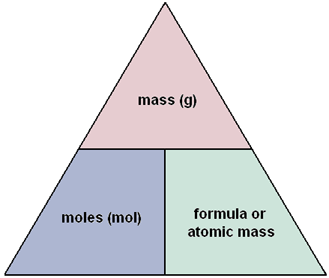
Using the above formula triangle, the moles, volume and concentration (molar volume) can be calculated in a chemical equation.

Thursday, 22 February 2018

Section 1 d) Specification

1.16 calculate relative formula masses (Mr) from relative atomic masses (Ar)

From the chemical formula of a compound, the Mr can be found by adding the individual relative atomic masses of each atom.
e.g. CO2
C = 12, O = 16
12 + (2 x 16) = 44

1.17 understand the use of the term mole to represent the amount of substance

A mole is the amount of a substance with the same number of molecules as Carbon 12 at a mass of 0.012kg (12g). Otherwise defined as having 6.022 x 10^23 molecules of it.

1.18 understand the term mole as the Avogadro number of particles
(atoms, molecules, formulae, ions or electrons) in a substance

Avagadro's number is how many particles of a substance there must be for its mass in grams to be equal to its relative atomic mass. Avagadro's number is 6.02214154 x 10^23, but at GCSE level we shorten it to 6.022 x 10^23 unless otherwise specified.

1.19 carry out mole calculations using relative atomic mass (Ar) and relative
formula mass (Mr)

The above formula triangle can be used to calculate different parts of a chemical formula.
Examples:

2Ca + O2 --> 2CaO
2mol 1mol    2mol
1 mole of any substance contains the same number of particles.
If we have 5g of Calcium, what mass of Calcium Oxide will we get?
Mass of Ca = 5g       Mr of Ca = 40       5 / 40 = 1 / 8 moles
The ratio of Ca:CaO is 1:1, so there is the same number of moles.
1/8 mol of CaO must be multiplied by its Mr to find the mass
Mr of CaO = 56      56 x 1/8 = 7
There are 7 grams of CaO from 5g Ca.

CuSO4 + Zn --> ZnSO4 + Cu
1mol     1mol     1mol      1mol
If we have 1.5g Zinc,  what mass of Copper will we get?
1.5g / 65 = 3/130 mol
ratio 1:1 so same number of moles
Mr of copper = 63.5
3/130 x 63.5 = 1.47 g

2Fe + 3Cl2 --> 2FeCl3
How much Chlorine is needed to react with 20g of Iron?
20 / 56 = 5/14 mol
ratio is 2:3 so we first divide by 2 to get 5/28
then multiply by 3 to get 15/28
we then find the Mr of Cl2     35.5 x 2 = 71
15/28 x 71 = 38 1/28 g

1.20 understand the term molar volume of a gas and use its values
(24 dm^3 and 24,000 cm^3) at room temperature and pressure (rtp) in
calculations.

1 mole of any gas takes up the volume of 24dm^3 at room temperature and Earth's atmospheric pressure. We can use this in gas calculations to calculate gas volumes, or use it the other way around and find how many moles there are based on its volume. 

Wednesday, 21 February 2018

Section 1 c) Specification

1.9 understand that atoms consist of a central nucleus, composed of protons
and neutrons, surrounded by electrons, orbiting in shells

An atom is composed of a nucleus, made up of positively charged protons and neutrons, which have no charge. Each of these sub-atomic particles has a relative atomic weight of 1.

The nucleus is surrounded by shells of negatively-charged electrons, which have a relative atomic weight of 1. The shells of an atom are described at GCSE level as the first shell containing 2 electrons, and further shells having a capacity of 8 electrons.


1.10 recall the relative mass and relative charge of a proton, neutron and electron

Proton: Relative mass 1, Relative charge +
Neutron: Relative mass 1, Relative charge 0
Electron: Relative mass 0, Relative charge -

1.11 understand the terms atomic number, mass number, isotopes and relative
atomic mass (Ar)

Atomic Number: The number of protons in an atom
Mass Number: The number of protons + the number of neutrons in an atom
Isotopes: Atoms with the same number of protons and electrons, but a different number of neutrons.
Relative Atomic Mass: The mass of an atom relative to Carbon 12.

1.12 calculate the relative atomic mass of an element from the relative
abundances of its isotopes

(Mass 1 x Abundance 1) + (Mass 2 x Abundance 2) + .....
_________________________________________________
                                           100       

1.13 understand that the Periodic Table is an arrangement of elements in order of
atomic number

The Periodic Table was developed by Mendelev as a way of organising the chemical elements by reactivity and characteristics. The patterns relate to the number of protons and electrons in each atom, and as a result the properties of undiscovered elements can be predicted fairly precisely. It is organised in chronological order of atomic number.
Each period relates to the number of shells of electrons, and each group relates to the number of outer shell electrons.

1.14 deduce the electronic configurations of the first 20 elements from their
positions in the Periodic Table

The first two elements are hydrogen and helium, which have 1 outer shell, with electronic configurations 1 and 2 respectively.
The second period contains 8 elements, with (left to right) electronic configurations
2,1 , 2,2 , 2,3 , 2,4 , 2,5 , 2,6 , 2,7 , 2,8
The third period resembles the second:
2,8,1 , 2,8,2 , 2,8,3 , 2,8,4 , 2,8,5 , 2,8,6 , 2,8,7 , 2,8,8
and so on.

1.15 deduce the number of outer electrons in a main group element from its
position in the Periodic Table.

The 8 groups of the periodic table tell us how many outer shell electrons the elements of the group have.
Group 1 : 1 valence electron
Group 2 : 2 valence electrons
etc.
etc.
Group 0 : full outer shell, so 2 or 8 valence electrons.

Thursday, 1 February 2018

Section 1 b) Specification

1.4 describe and explain experiments to investigate the small size of particles
and their movement including:
i dilution of coloured solutions
ii diffusion experiments

Experiment 1: Dilution
Add a coloured substance to a solvent, e.g. food dye to a solvent, e.g. water. Over time, the intensity of the colour will decrease as it spreads throughout the liquid and dilutes- the concentration of the food dye decreases. Dilution increases at higher temperatures due to increased kinetic energy of particles, so applying heat decreases the time it takes for the dye to become fully diluted.

Experiment 2: Diffusion
Using a glass tube, place cotton wool soaked in ammonia solution at one side of the tube, and cotton wool soaked in hydrochloric acid at the other end. Both ends should be sealed with bungs. After a few minutes, a white ring of ammonium chloride will form in the tube, closer to the hydrochloric acid end. This tells us that the particles have diffused away from their respective ends to collide and react. The ammonia particles are smaller than the hydrogen chloride particles, and therefore move faster which is why the ring forms closer to the hydrochloric acid.


Experiment 3: Diffusion
Place liquid bromine at the bottom of a glass jar, and another empty jar upside down on top of it. As the bromine begins to evaporate, you can observe the volume of liquid decreasing, and the gas in the jar changing colour as the darker-coloured bromine particles diffuse upwards.

1.5 understand the terms atom and molecule

An atom is the smallest particle of an element that can exist. It has balanced charge (the same number of positively charged protons and negatively charged electrons) and a mass relative to carbon (12), made up of the neutrons and protons, each with mass of 1.
A molecule is a group of atoms bonded together, the smallest unit of a chemical compound that can take part in a chemical reaction, e.g. H2O

1.6 understand the differences between elements, compounds and mixtures

An element is one type of atom found on the periodic table, sometimes found bonded to another atom of the same element, e.g. O2, but it is always pure.
A compound is two or more elements chemically bonded in fixed proportions to form a new molecule, e.g. CO2
A mixture is two or more compounds or elements that are not chemically bonded, e.g. air, or a metal alloy such as steel.

1.7 describe experimental techniques for the separation of mixtures, including
simple distillation, fractional distillation, filtration, crystallisation and paper
chromatography

Solutions can be separated using a number of different techniques based on the physical differences of the substance (e.g. soluble and insoluble compounds). These include distillation, decanting, sieving, filtration, chromatography, crystallisation and magnetic separation.

Simple distillation: A liquid is boiled in a distilling flask, and the vapor travels through a tube, where thermal energy is passed to the cool water outside it and the vapor condenses into a liquid. The purified liquid then trickles out into a beaker. This generally is used to separate two liquids in a mixture, with different boiling points (e.g. ethanol and water)

Fractional distillation: The apparatus is similar to simple distillation, but the addition of a fractionating column filled with glass or plastic beads that allows better separation between the fractions due to condensation and re-evaporation occurring on the surface of each bead (distilling the mixture repeatedly). This allows the separation of more complex mixtures of liquids.
More on distillation

Filtration: A mixture is passed through a funnel with filter paper in it. The insoluble solid is left on the filter funnel, while the solution passes through the paper as the particles are small enough to fit through the gaps in the paper. This is used to separated a solution and insoluble particles.

Evaporation: A solution is heated to evaporate the liquid (e.g. water) leaving behind a solid that was previously dissolved. This is used to retrieve soluble compounds from solutions.

Crystallisation: A solution (e.g. aqueous sodium chloride) is heated to its boiling point, allowing the liquid, in this case the water, to partially evaporate. The solution is then left over a period of time, often several days to allow further water to evaporate at a lower temperature, causing crystals to form.

Chromatography: Different pigments in a mixture can be separated using chromatography. Dots of dye are placed at regularly spaced intervals at the bottom of a piece of chromatography paper, and the paper is placed in a beaker of solvent (the solvent should not reach the dye so it isn't dissolved and dissipated into the solution). The solvent will travel up the paper, and dissolve the pigments. Heavier pigments will be carried a shorter distance than pigments with smaller particles.

1.8 explain how information from chromatograms can be used to identify the
composition of a mixture. 

Using a chromatogram, the composition of a mixture of dyes can be determined through comparison of different pigments. Different pigments are more or less water-soluble, and have different particle sizes, resulting in the pigments travelling a certain distance up the paper. By comparing a mixture of pigments, and marking the distance they travel, then comparing with individual pigments and the distance they travel, the composition can be determined. Pigments of the same kind will travel the same or similar distances.


Friday, 26 January 2018

Section 1 a) Specification

1.1 understand the arrangement, movement and energy of the particles in each
of the three states of matter: solid, liquid and gas
As shown in the diagram:

Solids have a fixed shape and volume. Their particles are arranged regularly and are tightly packed. They do not flow, and the particles vibrate about a fixed point. They have the strongest forces of attraction and are usually the most dense.

Liquids have a fixed volume, but their shape changes to fit the container. The particles have weaker forces of attraction than solids, but stronger than gases. The particles can flow over each other, and they are irregularly arranged.

Gases have no fixed shape or volume, they can be compressed, and they change shape to fit the container. They move randomly in different directions and collide with other particles. There are wide gaps between the particles and almost no forces of attraction between them.


1.2 understand how the interconversions of solids, liquids and gases are
achieved and recall the names used for these interconversions

Melting- Solid --> Liquid
Achieved by heating, increased thermal energy means the particles gain kinetic energy.

Boiling- Liquid --> Gas
Achieved by heating, increased thermal energy means the particles gain kinetic energy.

Freezing- Liquid --> Solid
Achieved by cooling, decreased thermal energy means the particles lose kinetic energy.

Condensing- Gas --> Liquid
Achieved by cooling, decreased thermal energy means the particles lose kinetic energy.

Evaporation- Liquid--> Gas
Some particles on the surface move faster than average and have enough energy to break the bonds and become a gas.

Sublimation- Solid--> Gas
Achieved by a sudden increase n temperature or high pressure conditions. e.g dry ice. 


1.3 explain the changes in arrangement, movement and energy of particles
during these interconversions.

Melting- The solid particles vibrate at an increasing speed with increased temperature until the forces of attraction can no longer hold them together, and it changes state.

Boiling- The liquid is heated to the point that all the forces of the attraction within it are broken and bubbles of gas are formed throughout the liquid.

Evaporation- Faster particles on the surface of the liquid have enough energy to break free from their bonds and evaporate to form a gas.

Condensing- The gas is cooled and the particles move slowly enough that they can form attractions between each other and form a liquid.

Freezing- If a liquid is cooled, the particles will begin to lose kinetic energy and their movement will slow until the forces of attraction will hold them in place as a solid.

Subliming- The particles gain kinetic energy very quickly, allowing all forces of attraction to break quickly and form a gas.

Thursday, 25 January 2018

Section 1: Principles of Chemistry Specification

a) States of matter

1.1 understand the arrangement, movement and energy of the particles in each
of the three states of matter: solid, liquid and gas

1.2 understand how the interconversions of solids, liquids and gases are
achieved and recall the names used for these interconversions

1.3 explain the changes in arrangement, movement and energy of particles
during these interconversions.

b) Atoms

1.4 describe and explain experiments to investigate the small size of particles
and their movement including:
i dilution of coloured solutions
ii diffusion experiments

1.5 understand the terms atom and molecule

1.6 understand the differences between elements, compounds and mixtures

1.7 describe experimental techniques for the separation of mixtures, including
simple distillation, fractional distillation, filtration, crystallisation and paper
chromatography

1.8 explain how information from chromatograms can be used to identify the
composition of a mixture.

c) Atomic structure

1.9 understand that atoms consist of a central nucleus, composed of protons
and neutrons, surrounded by electrons, orbiting in shells

1.10 recall the relative mass and relative charge of a proton, neutron and electron
1.11 understand the terms atomic number, mass number, isotopes and relative
atomic mass (Ar)

1.12 calculate the relative atomic mass of an element from the relative
abundances of its isotopes

1.13 understand that the Periodic Table is an arrangement of elements in order of
atomic number

1.14 deduce the electronic configurations of the first 20 elements from their
positions in the Periodic Table

1.15 deduce the number of outer electrons in a main group element from its
position in the Periodic Table.

d) Relative formula masses and molar volumes of gases

1.16 calculate relative formula masses (Mr) from relative atomic masses (Ar)

1.17 understand the use of the term mole to represent the amount of substance

1.18 understand the term mole as the Avogadro number of particles
(atoms, molecules, formulae, ions or electrons) in a substance

1.19 carry out mole calculations using relative atomic mass (Ar) and relative
formula mass (Mr)

1.20 understand the term molar volume of a gas and use its values
(24 dm3 and 24,000 cm3) at room temperature and pressure (rtp) in
calculations.

e) Chemical formulae and chemical equations

1.21 write word equations and balanced chemical equations to represent the
reactions studied in this specification

1.22 use the state symbols (s), (l), (g) and (aq) in chemical equations to
represent solids, liquids, gases and aqueous solutions respectively

1.23 understand how the formulae of simple compounds can be obtained
experimentally, including metal oxides, water and salts containing water of
crystallisation

1.24 calculate empirical and molecular formulae from experimental data

1.25 calculate reacting masses using experimental data and chemical equations

1.26 calculate percentage yield

1.27 carry out mole calculations using volumes and molar concentrations.

f) Ionic compounds

1.28 describe the formation of ions by the gain or loss of electrons

1.29 understand oxidation as the loss of electrons and reduction as the gain of
electrons

1.30 recall the charges of common ions in this specification

1.31 deduce the charge of an ion from the electronic configuration of the atom
from which the ion is formed

1.32 explain, using dot and cross diagrams, the formation of ionic compounds by
electron transfer, limited to combinations of elements from Groups 1, 2, 3
and 5, 6, 7

1.33 understand ionic bonding as a strong electrostatic attraction between
oppositely charged ions

1.34 understand that ionic compounds have high melting and boiling points
because of strong electrostatic forces between oppositely charged ions

1.35 understand the relationship between ionic charge and the melting
point and boiling point of an ionic compound

1.36 describe an ionic crystal as a giant three-dimensional lattice
structure held together by the attraction between oppositely
charged ions

1.37 draw a diagram to represent the positions of the ions in a crystal of
sodium chloride.

g) Covalent substances

1.38 describe the formation of a covalent bond by the sharing of a pair of
electrons between two atoms

1.39 understand covalent bonding as a strong attraction between the bonding
pair of electrons and the nuclei of the atoms involved in the bond

1.40 explain, using dot and cross diagrams, the formation of covalent compounds
by electron sharing for the following substances:
i hydrogen
ii chlorine
iii hydrogen chloride
iv water
v methane
vi ammonia
vii oxygen
viii nitrogen
ix carbon dioxide
x ethane
xi ethene

1.41 understand that substances with simple molecular structures are gases or
liquids, or solids with low melting points

1.42 explain why substances with simple molecular structures have low melting
and boiling points in terms of the relatively weak forces between the
molecules

1.43 explain the high melting and boiling points of substances with giant covalent
structures in terms of the breaking of many strong covalent bonds

1.44 draw diagrams representing the positions of the atoms in diamond
and graphite

1.45 explain how the uses of diamond and graphite depend on their
structures, limited to graphite as a lubricant and diamond in cutting.

h) Metallic crystals

1.46 understand that a metal can be described as a giant structure of positive
ions surrounded by a sea of delocalised electrons

1.47 explain the electrical conductivity and malleability of a metal in terms of its
structure and bonding.

i) Electrolysis

1.48 understand that an electric current is a flow of electrons or ions

1.49 understand why covalent compounds do not conduct electricity

1.50 understand why ionic compounds conduct electricity only when molten or in
solution

1.51 describe experiments to distinguish between electrolytes and nonelectrolytes

1.52 understand that electrolysis involves the formation of new substances when
ionic compounds conduct electricity

1.53 describe experiments to investigate electrolysis, using inert electrodes, of
molten salts such as lead(II) bromide and predict the products

1.54 describe experiments to investigate electrolysis, using inert
electrodes, of aqueous solutions such as sodium chloride, copper(II)
sulfate and dilute sulfuric acid and predict the products

1.55 write ionic half-equations representing the reactions at the electrodes during
electrolysis

1.56 recall that one faraday represents one mole of electrons

1.57 calculate the amounts of the products of the electrolysis of molten
salts and aqueous solutions.

Section 3 a) Specification

3.1 explain the terms homologous series, hydrocarbon, saturated, unsaturated, general formula and isomerism. A homologous series is a grou...