1.16 calculate relative formula masses (Mr) from relative atomic masses (Ar)
From the chemical formula of a compound, the Mr can be found by adding the individual relative atomic masses of each atom.
e.g. CO2
C = 12, O = 16
12 + (2 x 16) = 44
1.17 understand the use of the term mole to represent the amount of substance
A mole is the amount of a substance with the same number of molecules as Carbon 12 at a mass of 0.012kg (12g). Otherwise defined as having 6.022 x 10^23 molecules of it.
1.18 understand the term mole as the Avogadro number of particles
(atoms, molecules, formulae, ions or electrons) in a substance
Avagadro's number is how many particles of a substance there must be for its mass in grams to be equal to its relative atomic mass. Avagadro's number is 6.02214154 x 10^23, but at GCSE level we shorten it to 6.022 x 10^23 unless otherwise specified.
1.19 carry out mole calculations using relative atomic mass (Ar) and relative
formula mass (Mr)
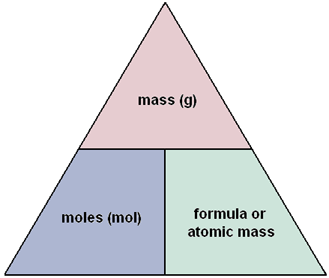
The above formula triangle can be used to calculate different parts of a chemical formula.
Examples:
2Ca + O2 --> 2CaO
2mol 1mol 2mol
1 mole of any substance contains the same number of particles.
If we have 5g of Calcium, what mass of Calcium Oxide will we get?
Mass of Ca = 5g Mr of Ca = 40 5 / 40 = 1 / 8 moles
The ratio of Ca:CaO is 1:1, so there is the same number of moles.
1/8 mol of CaO must be multiplied by its Mr to find the mass
Mr of CaO = 56 56 x 1/8 = 7
There are 7 grams of CaO from 5g Ca.
CuSO4 + Zn --> ZnSO4 + Cu
1mol 1mol 1mol 1mol
If we have 1.5g Zinc, what mass of Copper will we get?
1.5g / 65 = 3/130 mol
ratio 1:1 so same number of moles
Mr of copper = 63.5
3/130 x 63.5 = 1.47 g
2Fe + 3Cl2 --> 2FeCl3
How much Chlorine is needed to react with 20g of Iron?
20 / 56 = 5/14 mol
ratio is 2:3 so we first divide by 2 to get 5/28
then multiply by 3 to get 15/28
we then find the Mr of Cl2 35.5 x 2 = 71
15/28 x 71 = 38 1/28 g
1.20 understand the term molar volume of a gas and use its values
(24 dm^3 and 24,000 cm^3) at room temperature and pressure (rtp) in
calculations.
1 mole of any gas takes up the volume of 24dm^3 at room temperature and Earth's atmospheric pressure. We can use this in gas calculations to calculate gas volumes, or use it the other way around and find how many moles there are based on its volume.