Chemical Test: A test involving the chemical molecules, and the way they react with other molecules. e.g. test for water using anhydrous copper (ii) sulphate.
Combustion: Reaction with oxygen that produces a flame (a lot of heat and light energy is released)
Physical Test: A test involving the physical properties of a molecule, e.g. boiling point of water.
Thursday, 5 April 2018

Section 2 e) Specification
2.25 describe the reactions of dilute hydrochloric and dilute sulfuric acids with magnesium, aluminium, zinc and iron
The rule "MASH" tells us that when a metal reacts with an acid, a salt will be produced, as well as hydrogen.
Metal + Acid --> Salt + Hydrogen
e.g.
Mg(s) + 2HCl(aq) --> MgCl2 + H2
2.26 describe the combustion of hydrogen
The combustion of hydrogen is its reaction with oxygen. It is exothermic, so a lot of energy is produced, as well as pure water.
2H2 + O2 --> 2H2O
2.27 describe the use of anhydrous copper(II) sulfate in the chemical test for water
If anhydrous copper sulphate changes from white to blue, it has become hydrous copper sulphate and it contains water.
2.28 describe a physical test to show whether water is pure.
Heat the water until it boils, with a thermometer. If it boiled at 100℃ exactly, it is pure water.
The rule "MASH" tells us that when a metal reacts with an acid, a salt will be produced, as well as hydrogen.
Metal + Acid --> Salt + Hydrogen
e.g.
Mg(s) + 2HCl(aq) --> MgCl2 + H2
2.26 describe the combustion of hydrogen
The combustion of hydrogen is its reaction with oxygen. It is exothermic, so a lot of energy is produced, as well as pure water.
2H2 + O2 --> 2H2O
2.27 describe the use of anhydrous copper(II) sulfate in the chemical test for water
If anhydrous copper sulphate changes from white to blue, it has become hydrous copper sulphate and it contains water.
2.28 describe a physical test to show whether water is pure.
Heat the water until it boils, with a thermometer. If it boiled at 100℃ exactly, it is pure water.
Friday, 30 March 2018
Section 2 d) Summary
The Earth's atmosphere is made up of many different gases, including
- Nitrogen (78%)
- Oxygen (21%)
- Argon (0.9%)
- Carbon dioxide, Water vapour, etc. (>0.1%)
The last category includes greenhouse gases: Gases that trap the sun's energy inside the atmosphere, causing the greenhouse effect. This is usually a good thing; the greenhouse effect keeps us alive. But excess greenhouse gases are being released into the atmosphere, increasing the volume constantly (due to burning fossil fuels, etc.). This causes the enhanced greenhouse effect, where too much of the sun's energy is trapped and causes a heating effect called climate change. This is a dangerous process that is threatening the world we live in, and must be stopped.
We can work out the percentage volume of oxygen in air with a simple experiment.
- Place a tube containing copper in the middle of two gas syringes (containing a known volume of air), attached so the ends are sealed.
- Gently heat the copper with a bunsen burner, while slowly pressing the syringes, alternating, and keeping an eye on the volume.
- Once the volume stops changing when you press the syringe through, turn off the bunsen burner and wait for it to cool.
- Compare the volume you started with, and the volume you ended up with, and calculate the percentage. This is how much oxygen was in there.
Oxides can be formed by burning elements, for example:
- Burning magnesium forms magnesium oxide, a basic compound
- Burning sulphur forms sulphur dioxide, an acidic compound that can be dissolved to form sulphuric acid
- Burning carbon to form carbon dioxide, an acidic compound which has many uses but also contributes greatly to the enhanced greenhouse effect.
Carbon dioxide is water-soluble, making it useful for carbonating drinks. The carbon dioxide is dissolved under high pressure, but as this is a reversible reaction when the pressure is released bubbles form.
It is also denser than air, making it useful for smothering fires. CO2 is used in many fire extinguishers for this reason.
Carbon dioxide can be formed by reacting hydrochloric acid and calcium carbonate:
Hydrochloric acid + Calcium carbonate --> Carbon dioxide + Calcium chloride + Water
HCl(aq) + CaCO3(s) --> CO2(g) +CaCl2(s) + H2O(l)
Calcium carbonate could be used as marble or limestone, and dropped into a sealed flask of dilute hydrochloric acid in small pieces. A delivery tube could be placed in the end of the bung to allow for the gas to be collected in the downwards displacement method.
Carbon dioxide can also be formed through the thermal decomposition of a metal carbonate, for example:
Copper (II) Carbonate --> Carbon Dioxide + Copper Oxide
CuCO3 --> CO2 + CuO
Another decomposition reaction is hydrogen peroxide heated with manganese (IV) oxide.
Hydrogen peroxide --> Water + Oxygen
It is also denser than air, making it useful for smothering fires. CO2 is used in many fire extinguishers for this reason.
Carbon dioxide can be formed by reacting hydrochloric acid and calcium carbonate:
Hydrochloric acid + Calcium carbonate --> Carbon dioxide + Calcium chloride + Water
HCl(aq) + CaCO3(s) --> CO2(g) +CaCl2(s) + H2O(l)
Calcium carbonate could be used as marble or limestone, and dropped into a sealed flask of dilute hydrochloric acid in small pieces. A delivery tube could be placed in the end of the bung to allow for the gas to be collected in the downwards displacement method.
Carbon dioxide can also be formed through the thermal decomposition of a metal carbonate, for example:
Copper (II) Carbonate --> Carbon Dioxide + Copper Oxide
CuCO3 --> CO2 + CuO
Another decomposition reaction is hydrogen peroxide heated with manganese (IV) oxide.
Hydrogen peroxide --> Water + Oxygen
Section 2 d) Specification
2.16 recall the gases present in air and their approximate percentage by volume
Oxygen - 21%
Nitrogen - 78%
Argon - 0.9%
Other (carbon dioxide, water vapour, etc.) - >0.1%
2.17 explain how experiments involving the reactions of elements such as copper, iron and phosphorus with air can be used to investigate the percentage by volume of oxygen in air
If you have a known volume of air, then remove the oxygen by reacting it with an excess of another element (copper, iron, phosphorus) to create a solid, the volume of gas will change. This change can then be used to calculate the percentage of oxygen in the air. This can be done multiple times, and an average found, to increase the accuracy of the results.
2.18 describe the laboratory preparation of oxygen from hydrogen peroxide, using manganese(IV) oxide as a catalyst
Hydrogen peroxide can be decomposed simply by heating with a catalyst - Manganese oxide
Hydrogen peroxide --> Oxygen + Water
The oxygen bubbles created can be collected using the downwards displacement method.
2.19 describe the reactions of magnesium, carbon and sulfur with oxygen in air, and the acid-base character of the oxides produced
Magnesium burns in air, reacting with oxygen, to form magnesium oxide, a basic substance, as it is a metal oxide.
Magnesium + Oxygen --> Magnesium Oxide
Carbon and sulphur are both non-metals, that react with air, giving out heat and light, to form acidic non-metal oxides.
Carbon + Oxygen --> Carbon dioxide
Sulphur + Oxygen --> Sulphur dioxide
2.20 describe the laboratory preparation of carbon dioxide from calcium carbonate and dilute hydrochloric acid
Hydrochloric acid + Calcium carbonate --> Carbon dioxide + Calcium chloride + Water
HCl(aq) + CaCO3(s) --> CO2(g) +CaCl2(s) + H2O(l)
Calcium carbonate could be used as marble or limestone, and dropped into a sealed flask of dilute hydrochloric acid in small pieces. A delivery tube could be placed in the end of the bung to allow for the gas to be collected in the downwards displacement method.
2.21 describe the formation of carbon dioxide from the thermal decomposition of metal carbonates such as copper(II) carbonate
Copper (II) Carbonate --> Carbon Dioxide + Copper Oxide
CuCO3 --> CO2 + CuO
2.22 describe the properties of carbon dioxide, limited to its solubility and density
Carbon dioxide is a relatively dense gas, it is denser than air. It is water-soluble at high pressure, so when bubbled through water carbonic acid can be formed, and it turns lime water cloudy when dissolved.
2.23 explain the use of carbon dioxide in carbonating drinks and in fire extinguishers, in terms of its solubility and density
When carbon dioxide is dissolved into a liquid at a high pressure, it carbonates it. This reaction is reversible, so this means that when it is returned to atmospheric pressure, bubbles of carbon dioxide form again, and this is how we get fizzy drinks.
Carbon dioxide is used in fire extinguishers because it is denser than air, and is therefore good at smothering fires and preventing oxygen from reaching them. The carbon dioxide sinks over the fire in a blanket and stops oxygen from reaching it, which is necessary for combustion.
2.24 understand that carbon dioxide is a greenhouse gas and may contribute to climate change.
Oxygen - 21%
Nitrogen - 78%
Argon - 0.9%
Other (carbon dioxide, water vapour, etc.) - >0.1%
2.17 explain how experiments involving the reactions of elements such as copper, iron and phosphorus with air can be used to investigate the percentage by volume of oxygen in air
If you have a known volume of air, then remove the oxygen by reacting it with an excess of another element (copper, iron, phosphorus) to create a solid, the volume of gas will change. This change can then be used to calculate the percentage of oxygen in the air. This can be done multiple times, and an average found, to increase the accuracy of the results.
2.18 describe the laboratory preparation of oxygen from hydrogen peroxide, using manganese(IV) oxide as a catalyst
Hydrogen peroxide can be decomposed simply by heating with a catalyst - Manganese oxide
Hydrogen peroxide --> Oxygen + Water
The oxygen bubbles created can be collected using the downwards displacement method.
2.19 describe the reactions of magnesium, carbon and sulfur with oxygen in air, and the acid-base character of the oxides produced
Magnesium burns in air, reacting with oxygen, to form magnesium oxide, a basic substance, as it is a metal oxide.
Magnesium + Oxygen --> Magnesium Oxide
Carbon and sulphur are both non-metals, that react with air, giving out heat and light, to form acidic non-metal oxides.
Carbon + Oxygen --> Carbon dioxide
Sulphur + Oxygen --> Sulphur dioxide
2.20 describe the laboratory preparation of carbon dioxide from calcium carbonate and dilute hydrochloric acid
Hydrochloric acid + Calcium carbonate --> Carbon dioxide + Calcium chloride + Water
HCl(aq) + CaCO3(s) --> CO2(g) +CaCl2(s) + H2O(l)
Calcium carbonate could be used as marble or limestone, and dropped into a sealed flask of dilute hydrochloric acid in small pieces. A delivery tube could be placed in the end of the bung to allow for the gas to be collected in the downwards displacement method.
2.21 describe the formation of carbon dioxide from the thermal decomposition of metal carbonates such as copper(II) carbonate
Copper (II) Carbonate --> Carbon Dioxide + Copper Oxide
CuCO3 --> CO2 + CuO
2.22 describe the properties of carbon dioxide, limited to its solubility and density
Carbon dioxide is a relatively dense gas, it is denser than air. It is water-soluble at high pressure, so when bubbled through water carbonic acid can be formed, and it turns lime water cloudy when dissolved.
2.23 explain the use of carbon dioxide in carbonating drinks and in fire extinguishers, in terms of its solubility and density
When carbon dioxide is dissolved into a liquid at a high pressure, it carbonates it. This reaction is reversible, so this means that when it is returned to atmospheric pressure, bubbles of carbon dioxide form again, and this is how we get fizzy drinks.
Carbon dioxide is used in fire extinguishers because it is denser than air, and is therefore good at smothering fires and preventing oxygen from reaching them. The carbon dioxide sinks over the fire in a blanket and stops oxygen from reaching it, which is necessary for combustion.
2.24 understand that carbon dioxide is a greenhouse gas and may contribute to climate change.
Carbon dioxide is a greenhouse gas, meaning that it traps the sun's energy in the atmosphere, creating the enhanced greenhouse effect with excess. This excess heat that is not able to escape the Earth is a major cause of climate change.
Wednesday, 28 March 2018
Section 2 c) Summary
The group 7 elements, also known as halogens, are F, fluorine, Cl, chlorine, Br, bromine, I, iodine, and At, astatine. They all have antimicrobial properties, but in larger doses are toxic.
F - Fluorine - a pale yellow gas
Cl - Chlorine - a green gas
Br - Bromine - an orange liquid
I - Iodine - a purple solid
At - Astatine - a black solid
The halogens are in the same group, so have similar properties that show trends. As you go down the group, the elements get darker in colour, less reactive, and have a higher melting and boiling point.
The reason for this is because as the molecules increase in size, the distance between the valence electrons and the nucleus increases, weakening the forces of attraction and making it more difficult for the atom to attract another electron. Additionally, the increase in molecule size means the attraction between the molecules is more difficult to break, causing the increase in melting and boiling point.
This topic focuses primarily on fluorine, chlorine and bromine. Their reactivity series can be determined by combining a metal halide and aqueous halide, and seeing if a reaction takes place. By adding methylbenzene, we can see which molecules are present (purple is iodine, yellow is bromine)
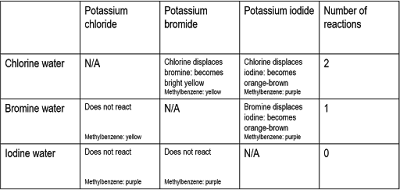
This shows that chlorine is the most reactive of the three, and iodine the least. These are displacement reactions, where the less reactive halogen is replaced by the more reactive halogen. The more reactive one is reduced, it gains electrons, and the less reactive one is oxidised, it loses electrons.

 The hydrogen halides formed in reaction with hydrogen can be bubbled through water, which is a polar substance. This causes the molecules to dissociate, and the H+ and halide- ions split, the H+ ions being acidic. This creates an acid, e.g. hydrochloric acid with chlorine, hydrobromic acid with bromine. This only works because water is a polar substance; it has charged ends. Non-polar substances, such as methylbenzene will not cause the compound to dissociate as the charge is evenly distributed.

F - Fluorine - a pale yellow gas
Cl - Chlorine - a green gas
Br - Bromine - an orange liquid
I - Iodine - a purple solid
At - Astatine - a black solid
The halogens are in the same group, so have similar properties that show trends. As you go down the group, the elements get darker in colour, less reactive, and have a higher melting and boiling point.
The reason for this is because as the molecules increase in size, the distance between the valence electrons and the nucleus increases, weakening the forces of attraction and making it more difficult for the atom to attract another electron. Additionally, the increase in molecule size means the attraction between the molecules is more difficult to break, causing the increase in melting and boiling point.
This topic focuses primarily on fluorine, chlorine and bromine. Their reactivity series can be determined by combining a metal halide and aqueous halide, and seeing if a reaction takes place. By adding methylbenzene, we can see which molecules are present (purple is iodine, yellow is bromine)

This shows that chlorine is the most reactive of the three, and iodine the least. These are displacement reactions, where the less reactive halogen is replaced by the more reactive halogen. The more reactive one is reduced, it gains electrons, and the less reactive one is oxidised, it loses electrons.

Reactions


Section 2 c) Key Words
Displacement reaction: A reaction in which a less reactive molecule is replaced with a more reactive molecule.
Dissociation: the splitting of a molecule into smaller molecules, atoms, or ions, especially by a reversible process
Group 7: The seventh group of the periodic table. Elements in this group have 7 valence electrons and are known as halogens. They share similar properties due to their similar electronic configurations.
Halogen: A group 7 element. Examples include chlorine and bromine.
Non-polar: A substance in which the electrons are shared equally between the nuclei, resulting in an even distribution of charge.
Oxidation: Loss of electrons
Polar: A substance in which the molecules are arranged so one end has a positive charge and on has a negative charge.
Reactivity series: The order of reactivity
Redox Reaction: A reaction in which electron(s) are transferred from one molecule to another. The molecule losing an electron is oxidised, and the one gaining is reduced.
Reduction: Gain of electrons
Dissociation: the splitting of a molecule into smaller molecules, atoms, or ions, especially by a reversible process
Group 7: The seventh group of the periodic table. Elements in this group have 7 valence electrons and are known as halogens. They share similar properties due to their similar electronic configurations.
Halogen: A group 7 element. Examples include chlorine and bromine.
Non-polar: A substance in which the electrons are shared equally between the nuclei, resulting in an even distribution of charge.
Oxidation: Loss of electrons
Polar: A substance in which the molecules are arranged so one end has a positive charge and on has a negative charge.
Reactivity series: The order of reactivity
Redox Reaction: A reaction in which electron(s) are transferred from one molecule to another. The molecule losing an electron is oxidised, and the one gaining is reduced.
Reduction: Gain of electrons
Section 2 c) Specification
2.9 recall the colours and physical states of the elements at room temperature
Fluorine, F : Pale yellow gas
Chlorine, Cl : Pale green gas
Bromine, Br : Orange liquid
Iodine, I : Purple solid
Astatine, At : Black solid
2.10 make predictions about the properties of other halogens in this group
Based on the information we know about fluorine, chlorine and bromine we can assume that as we travel down the group
2.11 understand the difference between hydrogen chloride gas and hydrochloric acid
Hydrogen chloride gas is the product of the reaction between hydrogen and chlorine. This can be dissolved in water to make it aqueous, causing the ions to be dissociated - detatched. This creates Cl - ions, as well as acidic H + ions, creating hydrochloric acid.
2.12 explain, in terms of dissociation, why hydrogen chloride is acidic in water but not in methylbenzene
Water is a polar substance, and methylbenzene is non-polar. Polar substances cause ionic bonding to be separated (dissociated), as the anions are attracted to the positive poles of the molecules, and the cations are attracted to the negative poles. This causes them to split. Non-polar substances aren't able to dissociate compounds in this way.
2.13 describe the relative reactivities of the elements in Group 7
They become less reactive as you go down the group, so larger elements are less reactive because the force of attraction between the nucleus and the valence electrons is weaker, so it is less able to attract another electron.
2.14 describe experiments to demonstrate that a more reactive halogen will displace a less reactive halogen from a solution of one of its salts
A more reactive halogen will displace a less reactive halogen bonded as a salt. For example, a sodium halide solution could be created for each of the halogens (potassium fluoride, potassium chloride, potassium bromide, etc.), then reacted with a halide solution, to discover the reactivity series:

Methylbenzene turns purple in presence of iodine, and yellow in presence of bromine. It can be added as a layer of indicator, showing us which substances are present (when bonded, does not affect indicator).
This series of experiments shows us that chlorine is the most reactive of these halogens, and iodine is the least, as chlorine water had the most displacements and iodine the least.
2.15 understand these displacement reactions as redox reactions.
Redox reactions are reactions that involve the loss and gain of electrons:
Oxidation
Is
Loss of electrons
Reduction
Is
Gain of electrons
When one more reactive halogen displaces a less reactive halogen, the more reactive halogen is reduced, and the less reactive one is oxidised.
 As you can see in the above equations, more reactive chlorine reacts with sodium bromide. Bromine is less reactive than chlorine, so it displaces it. In this process, the bromine loses an electron and bonds with itself to form diatomic molecules. The chlorine molecules bond with sodium, and gain an electron, reducing them and giving them a negative charge.
Fluorine, F : Pale yellow gas
Chlorine, Cl : Pale green gas
Bromine, Br : Orange liquid
Iodine, I : Purple solid
Astatine, At : Black solid
2.10 make predictions about the properties of other halogens in this group
Based on the information we know about fluorine, chlorine and bromine we can assume that as we travel down the group
- Reactivity decreases
- Melting and boiling point increase
- Elements get darker in colour
They all have antimicrobial properties in small doses, but are toxic in large doses.
2.11 understand the difference between hydrogen chloride gas and hydrochloric acid
Hydrogen chloride gas is the product of the reaction between hydrogen and chlorine. This can be dissolved in water to make it aqueous, causing the ions to be dissociated - detatched. This creates Cl - ions, as well as acidic H + ions, creating hydrochloric acid.
2.12 explain, in terms of dissociation, why hydrogen chloride is acidic in water but not in methylbenzene
Water is a polar substance, and methylbenzene is non-polar. Polar substances cause ionic bonding to be separated (dissociated), as the anions are attracted to the positive poles of the molecules, and the cations are attracted to the negative poles. This causes them to split. Non-polar substances aren't able to dissociate compounds in this way.
2.13 describe the relative reactivities of the elements in Group 7
They become less reactive as you go down the group, so larger elements are less reactive because the force of attraction between the nucleus and the valence electrons is weaker, so it is less able to attract another electron.
2.14 describe experiments to demonstrate that a more reactive halogen will displace a less reactive halogen from a solution of one of its salts
A more reactive halogen will displace a less reactive halogen bonded as a salt. For example, a sodium halide solution could be created for each of the halogens (potassium fluoride, potassium chloride, potassium bromide, etc.), then reacted with a halide solution, to discover the reactivity series:

Methylbenzene turns purple in presence of iodine, and yellow in presence of bromine. It can be added as a layer of indicator, showing us which substances are present (when bonded, does not affect indicator).
This series of experiments shows us that chlorine is the most reactive of these halogens, and iodine is the least, as chlorine water had the most displacements and iodine the least.
2.15 understand these displacement reactions as redox reactions.
Redox reactions are reactions that involve the loss and gain of electrons:
Oxidation
Is
Loss of electrons
Reduction
Is
Gain of electrons
When one more reactive halogen displaces a less reactive halogen, the more reactive halogen is reduced, and the less reactive one is oxidised.

Subscribe to:
Posts (Atom)
Section 3 a) Specification
3.1 explain the terms homologous series, hydrocarbon, saturated, unsaturated, general formula and isomerism. A homologous series is a grou...

-
 3.1 explain the terms homologous series, hydrocarbon, saturated, unsaturated, general formula and isomerism. A homologous series is a grou...
 -
Balanced equation: A chemical equation that is written so the numbers of molecules do not change from one side to the other of the equation....
-
Galvanising: Coating iron in zinc as a form of sacrificial protection. Oxidation: Gain of oxygen ions. Reactivity series: The order in w...